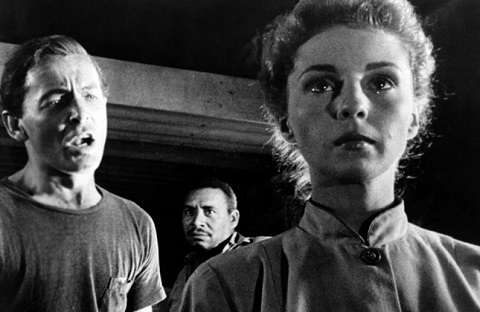
It has finally happened, around half a decade after its creation the atomic bomb has destroyed humanity on Earth, and they have nobody to blame but themselves. The smoke blows through empty streets, across deserted plains, and the silence is eerie, but what's this? Someone has survived! She’s a pregnant woman named Roseanne (Susan Douglas), and she has lost her husband, so is left to wander the wilderness alone, unsure whether she was blessed when she avoided the blast in her shelter or cursed for still being alive when everyone else has gone. But as her panic fades to exhaustion, she sees a house on a nearby clifftop, and makes her way there...
Although there had been occasional films depicting the apocalypse, and less occasionally the post-apocalypse, the nineteen-thirties epics Things to Come or Deluge probably the best known, Five was the first to depict that as being thanks to the onslaught of a nuclear war. Obviously in 1951 they were six years away from the weapons' use in World War 2, where they ended the conflict in the Pacific, but the fear that they could be used again had been in the air ever since, and you could argue has lasted to this day as it re-emerges in cycles over the decades. Part of the dread of this Sword of Damocles is not knowing how justified we are in worrying about the bomb.
Certainly the filmmakers of the nineteen-fifties capitalised on that terror by bringing it to fruition with a selection of science fiction flicks which took great glee in laying waste to Planet Earth, and because people like nothing better than to obsess over worst cast scenarios, a fair few of them were huge hits, especially with the younger generation who got a kick out of seeing, say, a giant spider menacing America, or space aliens using overwhelming technological advantage to truly mess up the day of everyone on the globe. However, not that many, in relative terms, took the approach of producer-director-writer Arch Oboler here, which was to take it all painfully seriously.
It's easy enough to theorise about a disaster that hasn't happened yet, it's a solid way for preventing them after all, but with Oboler his style was not to craft an adventure for the younger audiences so much as present a sober, considered plea to anyone watching his film not to let things get so bad that we more or less wipe ourselves out. To do so, his, yes, five survivors are representative of parts of the world as seen through American eyes, so Roseanne represented all of motherhood and femininity for instance, and later on Eric (James Anderson) was the threat of fascism raising its head, so of course he had a not quite identifiable, non-American accent marking him out as a wrong 'un to be eventually bested by the ostensible ideal of American manhood, Michael (William Phipps), though he too has his flaws.
For a start, after taking care of Roseanne in his Frank Lloyd Wright house (actually Oboler's) where he was getting used to the idea of solitude, he promptly tries to force himself on her, and this almost-rape casts a shadow across the rest of the drama. There were a number of sincerely meant aspects to Five that would likely go over the heads of the kids, so the sole black survivor, Charles (Charles Lampkin) represented spirituality and religion (though his recital of a Book of Genesis-inspired poem rendered this more blatant), and the elderly survivor Mr Barnstaple (Earl Lee) is the first of them to be sacrificed as not having what it takes to endure in this brave new world. In fact, Oboler was pretty ruthless about showing that life after the bomb dropped would be a whole bunch of misery, and the melancholy, depressive tone was surprisingly effective, even when he was otherwise heavy-handed. As the genre progressed in ways he would never have imagined, it was instructive to return to his epic on the cheap, with its cities full of skeletons, even if its deliberations tested the patience somewhat. Music by Henry Russell.