In Tokyo Sachiko Hanai (Emi Kuroda), a happy-go-lucky sex worker specializing in saucy schoolteacher role-play, wanders into a restaurant just as a North Korean secret agent (Takeshi Ito) guns down a Middle Eastern informant. Shot in the head by a stray bullet, Sachiko miraculously survives. She flees the scene after inadvertently picking up a cylinder containing a mysterious item sought by the North Korean agent. As a result of the bullet lodged in her cerebral cortex, Sachiko becomes a super-genius instantly able to comprehend existential philosophy, particle physics and arcane mathematical equations. She also develops a paranormal ability to glimpse the unseen mysteries of the universe and foretell future events. As a side effect however, Sachiko develops an even more insatiable appetite for sex. After seducing a helpful cop she then makes a move on hapless philosophy professor Toshio Saeki (Yukijiro Hotaro) who proves as besotted with her intellect as her libido. He then moves Sachiko into his home as a live-in tutor for his teenage son Mamoru (Tetsuaki Matsue) despite the suspicions of wife Kayoko (Kyoko Hayami). However, the murderous agent is still on Sachiko's trail and she soon discovers why. For the cylinder happens to contain nothing less than the severed finger of then US President George W. Bush (Shinji Kubo, wearing a paper cut-out George Bush mask!) able to trigger a stolen nuclear device. Not only that but the finger talks to Sachiko, relishes a chance to fondle her private parts and warns her about the impending apocalypse.
This wildly surreal, satirically-minded Japanese soft-core porn (or 'Pink Film') comedy caused a minor stir on the international film festival circuit back in 2004, during the immediate aftermath of the Iraq War. After opening on a typical skin-flick scenario wherein Sachiko's sexy schoolteacher act gets a bleach-blonde client all hot and bothered, The Glamorous Life of Sachiko Hanai rapidly segues from borderline slice-of-life realism down a much stranger path. A gritty verité look employing hand-held cameras (and dodgy sound recording) adds a degree of verisimilitude not inherent in the story which grows increasingly outlandish. The film was produced and scripted by Takao Nakano, a prolific V-cinema (the Japanese term for direct-to-video or on-demand) producer and occasional director. An outspoken fan of Seventies exploitation and 'excessive' cinema, Nakano parlayed his otaku obsessions into a string of low-budget genre films (e.g. Exorcister (1994), Sexual Parasite: Killer Pussy (2004), Big Tits Zombie (2010)) that while undoubtedly an acquired taste are sporadically imaginative.
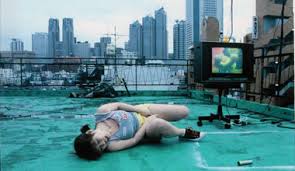
The Glamorous Life of Sachiko Hanai stands as Nakano's most ambitious production although it remains hard to discern how seriously viewers are meant to take its political satire and numerous philosophical allusions. On the one hand the film intermingles documentary footage of the geo-political fallout from George W. Bush's 'war on terror' with psychedelic animated sequences and references to chaos theory, Jean-Paul Sartre, Descartes, Kant, Milton's Paradise Lost and scholar Noam Chomsky. On the other hand it is very much a porno that segues from one silly sexual encounter to another, reaching an absurdist highlight on a rooftop where the reanimated presidential digit sends a naked, writhing Sachiko into orgasmic ecstasy ("I'm not waiting for permission from the U.N! This is the Bush technique, baby!") It is shot very much with a porn audience in mind with leery angles, instances where breasts and bums bounce into the camera lens and cum shots although as per Japanese censorship laws no frontal nudity. Voluptuous, uninhibited star Emi Kuroda is not an especially charismatic focal point. Likewise the script fails to paint Sachiko as anything more than a quixotic creature we never quite figure out. The closest it gets to profundity is the moment Sachiko directs Mamoru to her vagina which she describes as "the fundamental truth of the universe. Nietzsche, Einstein, the Earl of Sandwich, they all came from here").
Nakano's script attempts to draw a parallel between its own ridiculousness and the absurdity of the Iraq War, but the pseudo-intellectual posturing gets a bit first year film student-y. It is further hobbled by an all too typical Japanese pink film tendency towards cruelty including its inexplicable empathy for a multiple murderer and rapist at the expense of his victims. Lacking genuine intellectual rigour the film's ultimate conclusion that nonsense is the law of the world, change is futile, life meaningless and global annihilation could offer sweet relief is a trite exercise in nihilist chic. Director Mitsuru Meike does not bring much style to a package that barely holds together and, despite an appealing willingness to get crazy, proves something of a chore.