Lady Margaret Thatcher was the longest serving Prime Minister of the United Kingdom during the twentieth century, and the first woman to hold that position. However, she was ousted from government after eleven years by her own party and now, three years later, is about to conduct a tour of Britain and the United States of America to promote her book, an account of her three terms as the leader of the country. Documentary maker Nick Broomfield is determined to secure an interview with her, in spite of the fact that she is refusing to give interviews and only plans to appear at book signings where photographs may be taken and hold speeches which will not be open to the media. Undaunted, Broomfield begins his chase around after her, and his digging into Lady Thatcher's past uncovers some interesting facts - but will he be able to put them to her?
The informally titled Tracking Down Maggie is pretty much the quintessential Broomfield documentary and fits the typical style you'd expect to see from him. Basically, he wanders around trying to seize hold of his subject in a terrier-like grip, but by the end his tenacity comes up with nothing in particular. By turns amusing and exasperating, this film sees him engaging in an exercise in futility, where he appears to believe that the more he pursues Thatcher the more likely it is that she will talk with him, where it becomes obvious that the reverse is true as he keeps turning up like the proverbial bad penny at every engagement, despite the interest from his fellow members of the press dwindling to almost nothing.
At first, Broomfield goes back to Thatcher's childhood and tracks down her schoolfriends, who have little illuminating to say about her. He visits the site of her father's chemist shop, now a restaurant, but the owner doesn't want to speak to him. One ex-work colleague paints an unlikely portrait of a fun-loving Margaret singing "Baby, It's Cold Outside" in a duet at a party, but the more severe character we are familiar with asserts itself soon enough, as Broomfield charts her progress to the top, which was all under the apparent encouragement of her much-admired father. Her mother didn't have much influence over her, and when she married Denis Thatcher and her twins Mark and Carol were born, it's Mark who got all the attention, and so it continued throughout their lives.
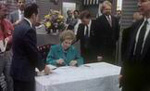
If the film has an unseen villain, it's Mark, who the increasingly paranoid and conspiratorial Broomfield suspects is manipulating things behind the scenes to keep Broomfield out of the picture (if the film has a visible villain it's the ever-present security man nicknamed Sniffer of the Yard). Time and time again, we witness the documentary maker forced to shoot footage of Thatcher either signing books or walking from her car to the steps of a building. All the while, Broomfield uncovers the truth behind Mark's shady arms dealings which put Britain at the number two spot in the league table of weapons dealing countries, all apparently endorsed by his mother who was making like easy for him. This is what Broomfield is most concerned about, and what he most wants to talk with Lady Thatcher about, although anyone can see it's never going to happen.
Anyone but Broomfield, that is. As the repetitive quality of the film wears the patience, you start to wonder what would happen if he actually did get his precious interview. We see that Thatcher has been carefully coached by the best media team money can buy to deflect any difficult questions, as when archive footage of a Robin Day television programme is shown and he is left floundering by her intimations that he is being less than patriotic by asking her questions about the arms deals. Would Broomfield be any better? When he finally does ask her about it, at a press conference at a Holocaust museum, she has the excuse that anyone asking her anything other than the reason she's visiting the museum looks to have a poor sense of judgement at best and finishes the conference after three minutes. But think of the alternative: Broomfield having to give up on his quest and no documentary to show for it, with only footage of the former Prime Minister's old toilet as a talking point. Music by David Bergeaud.
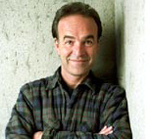
Pioneering British documentary-maker known for both the relentless pursuit of his subjects and his eagerness to put himself in his films. Broomfield's earliest films were observational documentaries covering such subjects as prostitution (Chicken Ranch), army life (Soldier Girls), and comedienne Lily Tomlin (Lily Tomlin). 1988's Driving Me Crazy introduced the style of film for which Broomfield would become famous, as he detailed his own failed attempts to film a musical.
Subsequent movies include two studies of serial killer Aileen Wuornos, the Spalding Gray monologue Monster in a Box, controversial Fetishes and a pair of documentaries on musical themes, Kurt & Courtney and the rap-exposé Biggie and Tupac. Broomfield has also made two forays into fictional film-making, with 1989's woeful thriller Diamond Skulls and 2006's true life immigration drama Ghosts. He returned to a true murder theme with Tales of the Grim Sleeper.