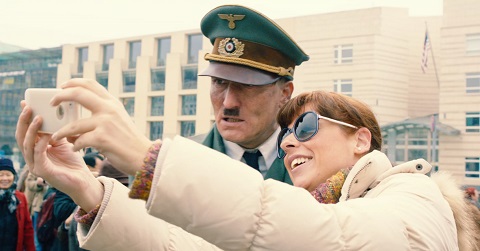
In Berlin, something strange has occurred, a man wakes up in some undergrowth and a football is kicked by some kids playing towards him. He is disoriented, but clambers to his feet and wonders what has happened - last thing he remembers is it being 1945 and he was in his bunker as the Second World War was going extremely badly for him. This is because the man is Adolf Hitler (Oliver Masucci), and somehow, through a quirk of time and space, he has wound up in the next century where he seems like a man whose place in history should be assuredly in the past, not the future year of 2014. But now that he is back, he is going to make the most of it and unite Germany...
A comedy about Hitler is a tricky proposition, as understandably the man who caused the deaths of millions is not exactly the most lighthearted guy around, but by adapting the controversial novel by Timur Vernes entitled Er ist wieder da director David Wnendt and his team attempted to shed new light on the personality and politics of one of the most hated individuals of all time. Well, it was really the politics that concerned them, and how it could be judged the world had moved on from them, or more to the point, if they had never gone away and indeed were informing the modern mindset in Germany and indeed across the globe. What they worked out was perhaps not too surprising.
But it was worrying, especially as Masucci refused to go the Dick Shawn in The Producers route and create a broad parody that begged to be laughed at: in fact, he played his Fuehrer disquietingly straight, allowing the humour to emerge from the reaction to him. This was largely a scripted, fictional affair, yet Wnendt saw fit to spruce it up with Candid Camera-style footage of Masucci in full uniform and makeup interacting with ordinary Germans of all outlooks to gauge their reactions to having Hitler back in their midst. Except it wasn't really, as he made no secret that they were being filmed, and that was all the more serious for a supposed comedy when these ordinary folk agreed with the former Chancellor.
Or rather, they agreed with the actor playing him and espousing his ideals, so there was a degree of artificiality there, yet the point made was that it didn't matter, once the public got used to this actor playing the role in convincing manner - he rarely makes fun of Hitler, a couple of sequences aside - they would behave much as if he was the real deal and had somehow been transplanted from the war years to 2014. That many of them agreed with him, and were secretly proud of having such an iconic figure as a focus for their issues with such hot topics as immigration, was designed, you could tell, to be a wake-up call to all those who liked to think Germany had moved on from their dark past; there were, it would appear, some elements of unlovely thinking that were part of the national character.
Mind you, you could say that of probably any nation in the world, they all have that potential for xenophobia and jingoism that many give in to, whether it assists them or not. The plot, away from Masucci mingling with the man and woman in the street, had Hitler discovered by a television journalist (Fabian Busch) desperately seeking a scoop to save his job and quickly put onto the small screen and the internet, those media that will be best at spreading his message. People think he is a comedian adopting a role, and laugh at him, but also find themselves agreeing at his appeals to the pride of Germany as the finest nation on the planet, and soon he is gaining momentum, not merely as a celebrity but once again as a statesman. Not even a faux pas caught on camera (which does seem out of character even for the embodiment of evil) can dent his popularity, as the journalist twigs what he has unleashed on society. The conclusion, bleak as it is, is that the world has moved to the right and will time and again embrace a populist fascist. Not that funny, and Masucci was not exactly a dead ringer, but keenly thought provoking, if too long. Music by Ennis Rotthoff.