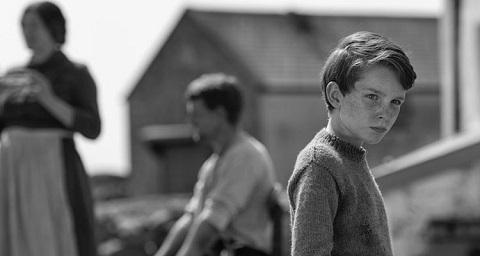
Joe Heaney was born in Ireland in the early twentieth century, into a rural community that had largely been unchanged for centuries, and as a child he became enamoured of the seannós, which was the local term for the folk songs of the region, so much so that he would sing them to himself in bed before he went to sleep. He also used to love exploring the landscape around his home, and this informed his outlook on life as he grew up, though initially he was reluctant to perform in public, practically forced to sing in front of his class at school no matter how much it embarrassed him. Nevertheless, the songs became a part of the fabric of his being, and the main connection to his past.
This was touted as an unconventional biopic of a singer who was not too well known outside of the folk music community, which made it sound rather forbidding and unwelcoming, as if the layman would sit down with it and be baffled as to what was going on. But really that was not accurate, for director and co-writer Pat Collins adhered to enough of the conventions of the form that it was wholly possible to follow Heaney's progress from an infant to an elderly gentleman with all the peripatetic behaviour in between. There was more than a touch of the wanderlust about this man, and that was hinted broadly to be part of the makeup of his Irish character, that need to get away.
But the music was uppermost in Collins' thoughts and depicting it was at least half the film, not always Heaney performing it, either, as we were given the chance to hear a variety of tunes that could be classed as Irish music. Obviously the seannós tradition was something that went back a formidable way, and to an outsider's ears it may sound as if it had something in common with Indian melody, or further afield to China and Japan, such was the distinctive manner with the delivery and arrangement, though often we heard Joe, at all ages, singing unaccompanied as was traditional which lent it a purity that even those unfamiliar with the style would be able to appreciate, no matter how alien it may seem.
There was no sense Song of Granite was designed to be exclusive to those rural Irish who would be accustomed to the seannós, as Heaney himself appeared to be a citizen of the world, even if as he entered his twilight years he longed to return to his homeland once more. Of course, the film was under no illusions about the havoc this played with his relationships, and in a move to more documentary fashion we saw vintage footage of the times and places he ended up, such as Glasgow in Scotland or New York City in the United States, but also heard the voices of two of his (now grown) children who lamented that as a father, Heaney was pretty much a disaster. Not thanks to what he did do, thanks to what he didn't do, which was not actually hang about and look after his young family.
There was a telling moment late on when one of his daughters, aware her father had been making an impression on the folk circuit, asks one of The Clancy Brothers to tell him that his wife had died, and could he contact his offspring because of that? He never did. Business like that could paint the subject as a heartless man, but Collins was keen to identify the romantic aspect, the lone wanderer who never settles down not because he is callous, but because he has something in his soul that will not be assuaged and he must drive forward to try and seek some form of succour that may forever be out of reach. This was all shot in steely black and white, which made it look appropriately from a distant age, despite the more modern trappings we could observe intermittently, and there were subtitles for when the language was in Gaelic. It wasn't exactly uplifting, more meditative than that, but shone a light on a life that would only be examined otherwise by the most dedicated enthusiast of the music. It was a good introduction, at least.
[Thunderbird's DVD has a strong, monochrome picture, the music is clear, and there's an interview and trailer as extras.]