Randolph Carter (Mark Kinsey Stephenson), a student at the Miskatonic University, regales his friends Howard Damon (Charles Klausmeyer) and Joel Manton (Mark Parra) with an old ghost story. In the Seventeenth century a young woman possessed by a demon was confined by her father to a house that stands just a stone's throw away from the graveyard where they sit now. Scoffing at Carter's outrageous tale Joel spends the night in the house alone and is brutally slain by the creature. Meanwhile Wendy Barnes (Laura Albert), Howard's unrequited crush, and her virginal friend Tania Heller (Alexandra Durrell) rashly accompany horny frat boys Bruce (Eben Ham) and John (Blane Wheatley) for some fun and games at the haunted house. Fearing the worst, Howard drags Carter along to investigate. Whereupon they come face to face with unnamable terror.
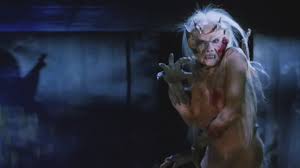
As more than one snarky critic pointed out at the time, The Unnamable actually does have a name. It is Alyda Winthrop. So there. Featuring impressive creature makeup by R. Christopher Briggs the film confines Alyda to the shadows for the most part. Alas, this sincere attempt at a slow-building atmosphere of anticipation and dread was undone by numerous horror magazines. These gave readers a far clearer glimpse of the creature than the filmmakers evidently intended. Adapted from a short story by legendary pulp author H.P. Lovecraft, The Unnamable was part of a minor wave of Lovecraft adaptations that rose in the wake of Stuart Gordon's fan-favourite Re-Animator (1985). Every decade or so horror filmmakers take a crack at Lovecraft. Around this time fans were also treated to Dan O'Bannon's The Resurrected (1991) and the anthology film H.P. Lovecraft's Necronomicon (1993) titled after Lovecraft's favourite tome that also appears in The Unnamable. For ardent Lovecraft devotees very few of these capture the unique sense of cosmic dread evoked by the author's work. However The Unnamable may well be the most charming Lovecraft adaptation. Of course it is an open question as to whether a Lovecraft story should be charming.
Much like those vintage adaptations produced by drive-in kings American International Pictures, e.g. The Haunted Palace (1963), Die, Monster, Die! (1965) and The Dunwich Horror (1970), The Unnamable operates more like a standard creature feature with little room for Lovecraft's mind-bending ideas. Yet it captures the personality of your typical Lovecraft protagonists pretty well. Mark Kinsey Stephenson's Randolph Carter proves an especially accurate translation: prissy, studious, borderline asexual but possessed of a keen analytical mind. In a neat joke Carter's less than dashing decision to hang back and crack open a book yields better results than Howard's tendency to blunder in heroically. The interaction between Carter and Howard is among the most likable facets of the the film. On the downside the female characters are rooted in archaic tropes from at least two decades prior. The plot reignites the old tiresome puritan horror film cliché of punishing the promiscuous girl. Meanwhile drippy heroine Tania is undone by both a woeful turn by Alexandra Durrell and one-note characterization that has her defined solely by a romantic obsession with Howard. At one point Tania initiates a puerile discussion about why girls with big breasts land all the men, leaving Howard bemused.
Much of Lovecraft's horror ideology is rooted in the author's neurotic fear of feminine sexuality. You get a hint of that here as the notably feminine creature is drawn as a ravenous beast that savages young men to death. Not a whole lot happens. Most of the film involves characters skulking around the old dark house. However Canadian director Jean-Paul Ouelette, who was second-unit director on The Terminator (1984) and cites Orson Welles and Russ Meyer among his mentors at film school (the latter explains that monologue about big breasts), crafts a nice Scooby-Doo atmosphere with some evocative lighting tricks. The frights never get under the your skin but prove consistent fun. There is a lot to be said for a compelling monster romp with likable characters, something beyond a great many filmmakers toiling in the horror genre. The film was successful enough to sire a more ambitious sequel: The Unnamable II: The Statement of Randolph Carter (1993).




 Display comments