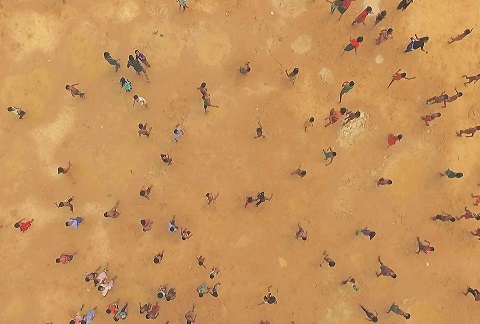
Sixty-five million people, that's how many have been displaced as refugees across the world thanks to war or famine as these people either find themselves forced out of their homes as a matter of survival, or seek a better life away from the crushing poverty they try to leave behind. Sadly, as they discover all too quickly, the life of a refugee can be just as harsh and bleak, and most of them face a grim future either in displacement camps or makeshift communities they have to set up, almost exclusively living hand to mouth on charity. The Chinese artist and activist Ai Weiwei has taken a great interest in this crisis, and Human Flow is his response in film to what he has seen.
In addition to this documentary, the director also set up art exhibitions in his own particular style to both publicise his efforts here and highlight the plight of the thousands of refugees he had encountered, although as this pointed out, not all of these displaced people were officially classed as refugees, hence the renaming of many involved as migrants. The difference, we find out, is kind of difficult to discern, but has something to do with how much aid they have available, and the motives they have for leaving their homes: there is a caption that informs us they can only achieve refugee status if they have been persecuted on racial, religious or social grounds, but that doesn't include all.
If there was one thing that came across watching this over two-hours-long work, it was that even at this expansive length this was too big a subject to be encapsulated in one film, and there was a sense that even the dedication of Weiwei was merely scratching the surface: with tens of millions of victims involved, how could it do otherwise? Nevertheless, the sheer scale of the issue landed with some force as he collected a series of scenes and shots of his subjects in twenty-three countries from Burma to Afghanistan to Turkey to Greece to France and even the United States, which has its own illegal immigrant problem that wasn't going away either, underlining the universality of this.
Of course, the fact that so many are classed as "illegal immigrants" was an issue in itself, and Weiwei did not get to grips with that as he preferred to put a human face to what was often depicted as wave upon wave of anonymous souls. To do that he selected various of them to interview individually, relating their hopes and dreams as well as the hell they were leaving behind, and how what they were experiencing now compared. They came across as being stuck in an impossible situation; while there was understanding concerning the countries they travelled to, there was a mood that patience was running out with the refugees and migrants thanks to their huge numbers, and not enough places for them to be settled, hence all those temporary camps most of them wound up in.
There was no doubt about why this was happening, and Weiwei blamed war almost exclusively. Syria was a flashpoint for the crisis, estimating six in ten Syrians had been forced out of their homes as a matter of survival, but others were taken into consideration too, including the Afghans and Iraqis elsewhere in the Middle East who had no choice but to evacuate, and the swathes of persons escaping famine in Africa, itself connected to war. Although the director occasionally placed himself in the frame, providing a playful presence curiously at odds with the tone (though one supposes the refugees could do with a laugh by this stage), we never heard his opinion directly, we had to draw our conclusions from what we were told and what had been recorded. There were also interviews with officials from the United Nations and others to flesh out the bigger picture, but answers were thin on the ground, with the overall impression this had got way out of control years ago and any solution was a mountain to climb, no matter how much hope Weiwei tried to put across. Music by Karsten Fundal.
[Altitude's Blu-ray presents some very sad imagery with true vividness, and has an interview with Weiwei as an extra.]