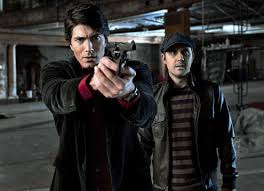
In New Orleans a suspected werewolf attack draws ace detective Dylan Dog (Brandon Routh), who specializes in hunting monsters, out of retirement. Urged by the victim's daughter, Elizabeth (Anita Briem) to catch the killer, Dylan investigates even though the case brings back painful memories of his late wife who was slain by vampires. Together with Marcus (Sam Huntington), his hapless sidekick, Dylan uncovers a labyrinthine conspiracy involving feuding vampire and werewolf clans, a powerful giant zombie and a monster hunter whose murder spree threatens to disrupt the peace between monsters and mankind.
Tiziano Sclavi's Italian comic book series, or fumetti, and spin-off novel has a huge fan-following in Italy. Acclaimed by fans and critics for its quirky combination of splatter, dark humour and existential philosophy, the book version was previously adapted for the screen by cult director Michele Soavi as Dellamorte Dellamore (1994) which many cite as the last truly great Italian horror film. The second adaptation, Dylan Dog: Dead of Night, comes courtesy of comic book mogul Scott Mitchell Rosenberg and veteran genre producer Gilbert Adler, whose horror credentials stretch back to the HBO series Tales from the Crypt. It marks the surprise live action directorial debut of animator Kevin Munroe whose other work includes TMNT (2007) and Ratchet & Clank (2016). Munroe makes the transition from computer animation to live action better than most. He not only crafts some solid monster sequences but comes up with creative ways to circumvent what was obviously a low budget. Nonetheless the film lacks atmosphere.
Relocated to the United States, Dylan Dog: Dead of Night presents a supernaturally infested New Orleans in more prosaic fashion than it really ought to be. Co-written by Thomas Dean Donnelly and Joshua Oppenheimer, the team behind A Sound of Thunder (2005), Sahara (2006) and the unpopular remake of Conan the Barbarian (2011), the script tries to evoke a noir-ish mood with gumshoe narration. But like far too many recent movies it over-relies on voice-over to fill in plot details. Another unfortunate problem is that many of Sclavi's then-pioneering ideas have been co-opted by other properties: e.g. the vampire nightclub in Blade (1998), the dark prophecy involving a feisty female monster-slayer in Buffy the Vampire Slayer (1997-2003) and the vampire-lycanthrope war in Underworld (2003). The most successful translation of Sclavi's morbidly witty work is a subplot that nonetheless evokes An American Werewolf in London (1981) wherein a supporting character comes back from the dead as a wisecracking zombie and eventually joins an undead support group. The film lacks the dense layers of symbolism, allegory and philosophical allusions found in Dellamorte Dellamore, but manages to convey a Sclavian stoicism in the face of cruel misfortune. Dylan's credo is: "Things never get better, they only get worse" but the plot reinforces the idea that one should endeavour to make the most out of life, even when you are dead. Sclavi's cynical distrust of conventional morality also comes through despite being muddled by the author's problematic depiction of women.
With the exception of a suitably showstopping demon transformation towards the end Munroe wisely downplays special effects for the most part. He leaves it to reliably shifty character players like Peter Stormare and Taye Diggs to embody monsters in human form. Brandon Routh, a hugely affable actor whose performance as the title character in Superman Returns (2006) was underrated and is currently a hoot as the Atom on DC comics' delightful TV series Legends of Tomorrow, is a solid lead. He does not quite embody the sardonic, brooding Dylan Dog haunted by lost love, but exudes his own quirky charisma.