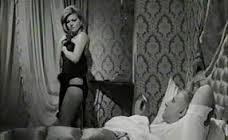
Carla Pratesi (Hélène Chanel), a glamorous call-girl in Rome, is unsettled by phone-calls from a heavy-breathing stranger. After bidding farewell to a wealthy client Carla wants to go to her father's birthday but is instead blackmailed by her boss, nightclub owner Luisa (Dada Gallotti) into partying with yet another man. However, on her way to the club Carla is ambushed and murdered by a creep resembling movie star Mario Vivaldi. Following a string of similar attacks, Inspector Ferretti (Alberto Lupo) is assigned to the case but discovers Vivaldi has a cast-iron alibi. When a prostitute narrowly survives another attack she identifies the killer as yet another actor named Sandro Mari. It dawns on Ferretti that the maniac is disguising himself with different movie star masks. While the police are distracted investigating the call-girl ring involving several well-connected individuals, the maniac goes to desperate lengths to pursue more women.
One might call Night of Violence a proto-giallo given it hails from that nebulous period post-Mario Bava's Blood and Black Lace (1964) and pre-Dario Argento's The Bird with the Crystal Plumage (1969) when Italian murder-mysteries were still finding their feet. Indeed overseas the film was billed on the grindhouse circuit as a sexploitation picture under the alternate title Call Girls 66. Filmed in glorious black and white by D.P. Vitaliano Natalucci it features some lovely night-time shots of Rome at the height of Sixties' la dolce vita. Roberto Mauri, an exploitation workhorse who dabbled in everything from spaghetti westerns to hardcore porn, imbues an otherwise threadbare story with an interesting shadowy noir look midway between Italian neo-realism and a Robert Siodmak psycho-thriller.
Laden with jokey references to leading figures in the Italian film industry like Federico Fellini, Pier Paolo Pasolini and Sophia Loren, the screenplay co-written by Mauri and future director Edoardo Mulargia seems to aiming for some sort of social satire. Take the scene where a young prostitute laments she came to Rome to become an actress but wound up sexually servicing rich bastards. Yet these attempts at social realism jostle uneasily with other, slightly more flippant B-movie aspects including the killer's ludicrously life-like disguises and a third act twist that ties his tragic backstory to, of all things, the Hiroshima bomb! Throughout a talky, meandering plot Mauri indulges in lots of padding with travelogue footage, cutaways to teenagers twisting on the dance-floor and soap opera like scenes full of florid Italian monologues. There are several abrupt detours as Night of Violence repeatedly abandons its stance as a semi-verité to embrace other genres like the police procedural, family melodrama (as Carla's grieving sister (Marilú Tolo) refuses to believe she was a prostitute) and eventually gothic horror, climaxing with a tasteless crash-zoom on the killer's mutated face.
Coming across like some kind of neo-realist Phantom of the Opera the third act invites viewers to empathize with a frustrated rapist. His continuous pleas of innocence prove dubious to say the least given even with the cops on his tail he never stops stalking and trying to attack women. Even so Night of Violence must rank among the few gialli where the maniac repeatedly fails to claim more victims. Time and again his attacks get curtailed by policemen or a helpful citizen although the film strangely makes a point of having them frustrated with these women's willingness to endure endless abuse rather than talk. Night of Violence is nowhere as explicit as later examples of the genre. Yet as with a frustrating amount of Italian exploitation (and sometimes mainstream) cinema the casual misogyny leaves it tough to enjoy. It is difficult to discern if the film is aiming for satire or merely indifferent when Inspector Ferretti squeezes information out of call-girl Linda (Lisa Gastoni) then callously ignores her plea for police protection. By comparison he is oddly affable around the parade of sex-trafficking gangsters, abusive pimps and shifty businessmen that populate the supporting cast. After that it is little wonder the film ends with a woman feeling sorry for the man that brutally raped and murdered her sister because all he wanted was love. Awww.