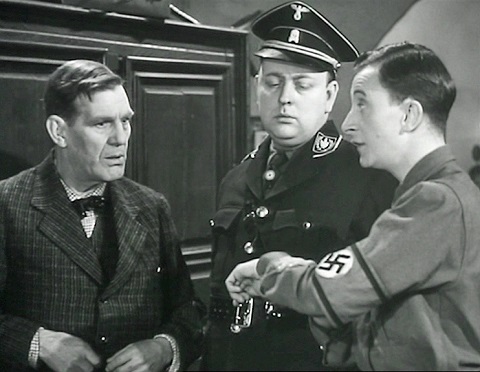
At a British air field, a man boarding a plane is stopped by officials, but when confronted he produces a pistol and starts firing at them: he is a Nazi spy who has been gathering intelligence in the country to take back to Germany. However, at Army headquarters in London, a very different man has been brought in for the crimes, a teacher called William Potts (Will Hay) who protests he had never heard of this Herr Muller he has been accused of being, not that the authorities are willing to accept this, they know Muller is a master of identities. But just as Potts has persuaded them to telephone his school for confirmation, the real Muller is brought in and the resemblance is uncanny - could the Brits turn the tables on the Nazis?
Just about every comedian who was around in World War II-era Britain had a crack at the propaganda game, and humour was a very effective weapon as Hollywood discovered, sending up what was a deadly serious business and making the beleaguered audiences across the globe feel better about the war effort. The Goose Steps Out was not Will Hay's only anti-Nazi comedy, but it was his highest profile, and a substantial hit with his adoring public who loved his blustering incompetent act that had made him a star of stage, screen and radio. Here he was required to be a little more canny than some of his characters, obviously with a degree of bumbling since that's what audiences liked to see, but there was no way Potts was going to fail in his mission.
That mission was to go behind enemy lines and impersonate Muller, which as Potts has just been sacked and is therefore at a loose end, sounds like a reasonable idea to him. Parachuted into Germany, he takes his looky-likey's position in a Hitler Youth school and starts trying to find out all he can about a new bomb being developed at a nearby laboratory, with a view to bringing one back to Blighty so our scientists can work out how to neutralise it. Naturally, this is easier said than done, especially with a man like Potts, but Hay's asides were purely to make the audience laugh and rarely picked up on by the bad guys, his manner of almost blowing the entire operation with his mix-ups part of a cultural difference in that the Nazis would not get his references and observations.
But the World War II moviegoers assuredly would, and be highly amused at even a supposed incompetent like Hay's famed schoolmaster character managing to get away with so much under the noses of the Third Reich. There were perfectly serious wartime movies made at the same time, of course, but the comedies were a breed to themselves, portraying a world in peril but never so much that a happy ending was in doubt, and that the evil could be vanquished by laughing at it thus defusing its potency. Sadly, this would be Hay's penultimate film before ill health forced him to leave the limelight, but part of the appreciation the public had for him rested in the knowledge that he was actually a very clever man indeed, particularly in the realm of his beloved astronomy in which he was an expert.
He was also an accomplished pilot, which rendered the grand finale where Potts tries and largely fails to fly a plane even more of a wink to the viewers; there was plenty reassuring for them that Hay was in real life smart as a whip, but deigned to play the fool for our entertainment, as it made him seem like a good sort. As usual, he was supported by some well-chosen British actors, most prominently Charles Hawtrey, best known for the Carry On series but here as his schoolboy persona in a Hay film that had made a name for him - although the star was best known for his teaming with Moore Marriott and Graham Moffatt, Hawtrey was just as reliable a foil, no matter that he was getting somewhat long in the tooth to be playing teenagers (he was in his late twenties here). There is the regulation array of clueless Nazis to overcome, a message that not everyone in Germany supported them (an important distinction at the time), and many digs at Adolf Hitler, the most blatant target for the humour, as ever in these propaganda exercises. Not Hay's best comedy, true, but he was funny enough and this was historically interesting enough to be worthwhile. Music by Bretton Byrd.