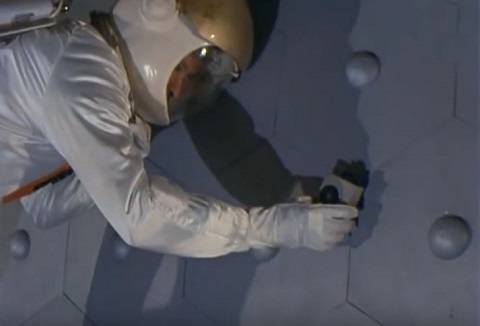
There is something strange happening at the outer edge of our Solar System, something advancing on Planet Earth with alarming speed that the world's scientists have been tracking and growing more concerned about. With good reason, for as a hastily arranged conference reveals there is footage available of a group of Italian astronauts who fell prey to the mysterious force: the boffins watch in horror as the crew seemingly go insane without rhyme nor reason. But what can they do if everyone who ventures out to investigate is stricken with this space madness? The answer is to send out another expedition, but one augmented with robot doubles of the crew as back up to any problems that may arise...
Yeah, that'll do it. Orion's Loop was part of the Soviet love of science fiction, in films and literature, where the future would be led by their nation's pioneering ways and they had no inkling that by 1989 the nation would have to face up to the fact that it just wasn't going to happen. Although released in 1981, this was not exhibiting much progress on from most of what had gone before, if anything it looked as if it was about ten or fifteen years out of date, or that the genre was stagnating in the cinema of the Soviets. What it most resembled was Andrei Tarkovsky's epic classic of the form Solaris, as if that was the benchmark it was referencing was the ne plus ultra of science fiction as far as they were concerned.
Which was all very well, Solaris was quite the achievement, but it did indicate nobody in Soviet cinema was willing to move on to either greater heights, or even try something a bit different. Elsewhere in the Eastern Bloc there were more experimental efforts in this format as the eighties wore on, but Orion's Loop looked primitive and backward, still in the quaint notions of Earthmen meeting the benevolent space brothers rather than questioning such complacency with something more provocative. A sense of humour might have helped, but with its special effects not much more advanced than an episode of sixties Star Trek it could not muster so much as one dazzling visual in its eighty-minute running time.
There were plenty of superimpositions of nebulae or floaty alien folks who visit the crew of the Phaedron as they explore the mysteries of the titular Orion's Loop, so-called by the scientist because it hails from the constellation of Orion (these aliens have evidently come a long way - I hope they went to the toilet before they left). Once near Pluto, they are visited by visions of strange individuals who seem to be trying to tell them something, but obviously cannot come right out and say what they mean or the movie would be considerably lot shorter. Besides, the Captain thinks they are either hallucinations or holograms created by the alien race, and it treating them with suspicion, little wonder when they start harping on about a "glass virus".
Precisely what that was remained rather obscure, but it was a threat, that much we did know, as was the space consciousness' habit of sending Earthmen and women they meet doolally, though the solutions the Phaedron adventurers invent were odd, to say the least. This involved donning headsets that made them experience their pasts, happier times that grounded them, a direct lift from the scenes in Solaris where the crew of the space station get caught up in crippling nostalgia though here with far less resonance since it was difficult to divine any possible benefits. By this point you may be wishing for a space monster to shake things up, but no such luck, there was merely a spot of craziness on the part of one crewmember who seeks to destroy the ship's computer, itself a cliché in a film that in spite of its brief running time dragged its heels tediously. Every so often you would get a feel for what the director Vasili Levin was aiming for yet was scuppered by a lack of budget, so mostly Orion's Loop was past its prime, and had been when it was first made. Music by Aleksandr Zatsepin.