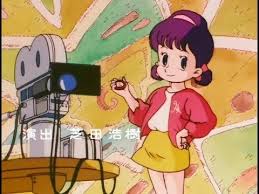
Ten year old Akko (voiced by Mitsuko Horie) is an ordinary little girl with an extraordinary secret. With the aid of a magical compact mirror given by a fairy as a reward for her kindness, she can transform herself into any form: human or animal. With these powers Akko helps friends and neighbours around her quiet little town. When a construction company plan to bulldoze the local playground to make way for a new shopping mall, Akko encourages chunky tough kid Taisho to wrangle all the neighbourhood kids and launch a protest. Unfortunately Taisho discovers the man behind the construction work is his Dad. As tensions flare between father and son, Akko adopts various alter-egos to try and change the old man's mind. Later the kids spend their summer holidays on the coast with Grandpa Minamoto (Kohei Miyauchi). He warns them to stay clear of a sacred island that is home to a white dolphin (Mika Doi) many local fishermen view as a god. But Taisho and the other boys scoff at such superstitious nonsense. They sneak off to catch themselves a rare white dolphin. So Akko dons another magical disguise to save the white dolphin and teach the boys a lesson.
Along with Little Witch Sally (1966), Secret Akko-chan was one of the progenitors of the magical schoolgirl genre that became as much a staple of Japanese animation as giant transformer robots. Originally broadcast in 1969 the anime series was adapted from a manga created by Fujio Akatsuka, better known in Japan as the king of gag comics. Later, hugely popular adaptations of Osamatsu-Kun (1966) and especially Genius Idiot Bakabon (1971) better encapsulate the zany spirit of Akatsuka's work which drew inspiration from funnymen like Charlie Chaplin, Bud Abbott and Lou Costello and Jerry Lewis. However, although based on an earlier, seemingly less personal manga, the comparatively genteel Akko-chan endures. Twice revived on television in 1988 and 1998 and even as a live-action feature: Akko's Secret (2012).
Released together on home video the two 1989 Secret Akko-chan 'movies' originally played theaters as part of Toei Animation's 'Wonder Festival': a summer package of short (typically fifteen to twenty-five minute long) spin-off from popular children's shows, both animated and live-action. A typical triple-bill might comprise two cartoons plus a short sentai (superhero) outing for Ultraman or Kamen Rider. In Japan these theatrical packages endure to this day and while titles change their content remains more or less the same. The interesting thing about the Secret Akko-chan revival is how the animators skillfully preserve the nostalgic sweetness of the original yet subtly update the formula to reflect (one might even say anticipate) topical social issues. 1989 saw Japan at the height of its rapidly expanding economy with materialism at its most rampantly defiant of traditional values. And yet both Akko-chan films have the protagonist and other kids champion the environment or simple working class needs in the face of the prevalent consumerist culture.
Unusually for a magical schoolgirl Akko does not fight monsters or cosmic threats. Instead she solves problems affecting ordinary everyday folk. Both short films see Akko use her magical shape-shifting powers to teach important life lessons. She helps Taisho's dad recall how much the playground meant to him as a lad then teaches the dolphin-hunting boys to respect both the environment and regional customs. Both stories anticipate ideals that would fully flower in Japanese mainstream culture in the mid-Nineties following the economic recession. In a conceit similar to Osamu Tezuka's more thematically ambitious Marvelous Melmo (1971) Akko regularly morphs into a sexy grownup alter-ego yet retains the mindset of a child. As a result, despite good intentions, her lack of maturity leads to the odd mishap and misunderstanding. That Akko intervenes without revealing her powers or showing anyone up reflects a certain conservative Japanese male ideal of femininity as strong, yes, but mostly nurturing, maternal and silent. Even so this lively, lighthearted fantasy reveals a subtle feminist streak.