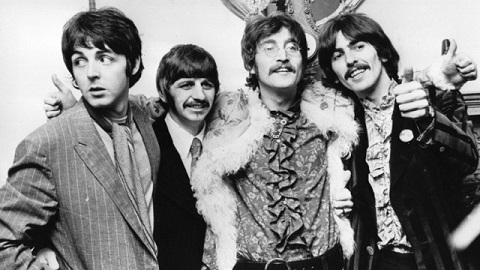
In August 1966, The Beatles were not only a popular music band, they were a phenomenon, the most famous quartet of young men on the planet and everyone wanted a piece of them. Well, almost everyone: when a bit of interview was unearthed where one of their number, John Lennon, had been of the opinion that The Beatles were "bigger than Jesus", as the quote that went around the world had it, controversy reigned, especially in the United States where their records were burned on bonfires in the Deep South, they were decried in the pulpits by fire and brimstone preachers, and they received death threats. This led to a question mark hanging over whether they would tour there at all...
How do you make a documentary about The Beatles without using any of their music, or even any one single album cover to illustrate what your interviewees were discussing? Considering how celebrated Sgt Pepper's Lonely Hearts Club Band was, which this was championing, it did seem a pity that the production could not afford to splash out on the rights to even short clips of their actual subject matter, but here we were, with the film carried on the strength of the news footage they had of the Fab Four, along with those talking heads who more often than not had known the band at the time this was concentrating on.
This had been designed to cash in on the fiftieth anniversary of the release of the aforementioned album in 1967, and as a result came across as a BBC Four documentary that had cut out any note of the Beatles' tunes, or a two hour DVD extra. Director Alan G. Parker had made a career out of these interviews 'n' stock footage assemblies, so by the point this was manufactured he well and truly had the hang of it, therefore no matter how much you missed the bigger names who were discussed but only seen in archive (Paul McCartney and Ringo Starr were not forthcoming in 2017), the anecdotes that were on offer were ample to sustain the interest in a film that from some angles resembled a "hanger-on" that was discussed here.
Still, you were offered a very clear idea of what led to the Pepper album and what it subsequently led to itself; essentially, The Beatles were sick of touring to play before fans who simply screamed at them and did not take in their music, and encounters in the United States, as well as getting beaten up by President Marcos's goons in the Philippines and receiving more death threats in Japan, meant their heart just was not in travelling the planet performing concerts anymore. Thus they retreated to the studio, and crafted a double A side single, Penny Lane/Strawberry Fields Forever, which was not merely revolutionary as a work of art as a whole, but pointed them in the direction of what would be one of the most famous albums of all time, and probably the best known album of the nineteen-sixties.
But in addition this was the tale of Brian Epstein, whose influence over his boys ebbed away as they gave up the concerts he was always so adept at organising, and as he felt increasingly irrelevant he took to a self-destructive lifestyle fuelled by pills and booze which would kill him after Sgt Pepper was released. Then we see The Beatles had been captivated by the Maharishi, and that excruciatingly embarrassing interview with the press where John and George Harrison try to explain that Brian was not dead, he had gone onto another plane of existence was rolled out once again, offending Epstein's family and friends and lessening the band's interest in the Indian guru. It would have been nice to hear more about the music, which tended to be relegated to a passage in the middle and even then none of it was on the soundtrack (faux Beatles instrumentals were present instead), but as the sort of thing that shows up on an arts channel (though this did have a cinema showing) it was informative enough, with people who knew what they were talking about, to take a perfectly decent second place behind the Ron Howard documentary that had been out a few months before.