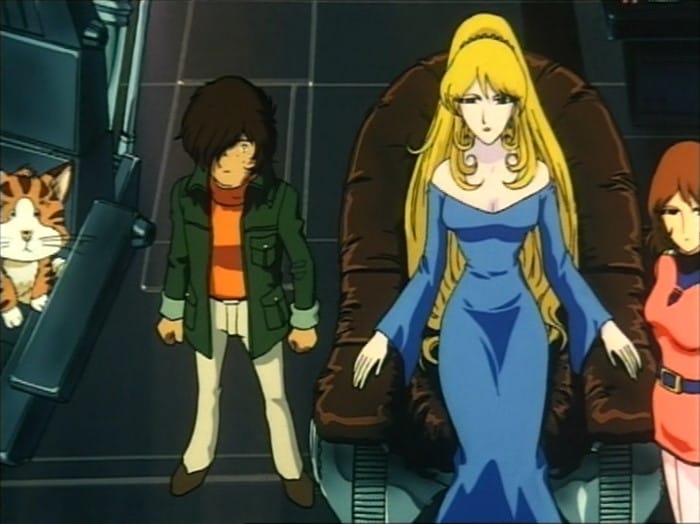
When giant meteors obliterate almost all life on Earth, a beautiful blonde space entity called Mello (voiced by Yuko Minaguchi) projects her 'cosmic consciousness' to visit humanity. She arrives in the year 2024 where a small ragtag band of survivors, including plucky orphan boy Daiba (Megumi Okada), saké-swigging scientist Professor Shimonoka (Ichiro Nagai) and his lovely assistant Yumi (Mariko Koda), struggle under an oppressive military cartel called Trader Force. Contacted telepathically by Mello, Daiba learns he has hitherto dormant psychic abilities. It turns that Daiba is an 'evolved lifeform' together with gutsy female fighter pilot Rei Yuki (Tomoko Sakai) and an unknown third party who turns out to be a cat named Mii voiced by Japan's most popular voice actress: Megumi Hayashibara (who, among other roles, voices Pikachu in Pokemon (1998)). Inside them lies the future of human civilization.
After a relatively fallow period throughout most of the Nineties, Leiji Matsumoto, Japan's master of grandiose space operas in manga and anime, resurfaced in the latter half of the decade with a series of new works. These continued into the millennium where Matsumoto's pop video for dance music duo Daft Punk, and subsequent feature-length spin-off Insterstellar 5555 (2003), gained him a new generation of fans. Of course while Fire Force D.N.A. Sights 999 was technically an original work, like most of Matsumoto's output, it recycles themes and motifs prevalent throughout all his space operas. In fact the plot leaves room for deus ex machina guest star cameos from Matsumoto's iconic space pirate Captain Harlock (1978) and Space Battleship Yamato (1974).
Described by the author himself as "a space opera that also focuses on Earth's environmental problems", D.N.A. Sights 999.9 fits into a cycle of eco-conscious anime prevalent at the time: e.g. Green Legend Ran (1992), Earth Maiden Arjuna (2001), etc. Despite a brief, forty-five minute running time both plot and visuals prove epic in scope, filled with moments of cosmic wonder right from the apocalyptic intro. It presents a credible post-apocalyptic society sprung from Matsumoto's own memories of the aftermath of the Second World War. Among the motifs familiar from past Matsumoto manga and anime we have the boy hero haunted by the loss of his mother who fixates upon a mystical maternal substitute. As with the classic Galaxy Express 999 (1979), Matsumoto makes his nurturing mother figure a spiritual avatar for the Shintoist concept of life itself who exerts an almost erotic-romantic hold upon the boy hero. Like Tetsuro in Galaxy Express and Tadashi in Captain Harlock, Daiba stands in for every embittered, grief-stricken war orphan forced to bear the sins of their forefathers. Tension arises from his uncertainty about trusting Mello, especially when the bad mother figure: Mistress Photon (Mami Koyama), the alien queen behind Trader Force, reveals the former had more to do with the meteor strike than she is letting on.
When Matsumoto's early anime were first released in the west critics charged him with ripping off Star Wars (1977), unaware that he pioneered similar story concepts several years before. However, certain aspects of D.N.A. Sights 999.9 cannot help but evoke Star Wars like when Daiba climbs into a space fighter and hears Mello talking in his head like Obi-Wan Kenobi. A few plot elements even anticipate those found in Star Wars – Episode One: The Phantom Menace (1999) and Star Wars: The Force Awakens (2015) while the concept of youngsters with innate abilities marking the next stage of human evolution also echoes the Newtypes from Mobile Suit Gundam (1979). In addition the concept of the 'Fire Force' binding all life in the universe together recalls Osamu Tezuka's sprawling multi-volume manga The Phoenix, adapted as the like-named 1978 live-action/anime hybrid and fully animated Phoenix 2772 (1979). Which is not to say Matsumoto does not inject his own concepts such as the notion that the Earth as one giant living organism made of multiple moving parts/civilizations with intertwining agendas, or the uplifting climax that posits mankind is predestined to leave planet Earth behind, much as a child eventually leaves its parents, to venture into the stars. Alongside Matsumoto's typical combination of melancholy, romanticism and hopeful optimism, the anime upholds his signature unorthodox visuals that combine two distinct art styles. Squished-down cartoony Charles Schulz-like everyman protagonists and a more classical rendering for heroes and (typically blonde and leggy) women reflecting the author's youthful infatuation with French actresses like Catherine Deneuve. The score, by Katsuo Ono, is also a combo melding classical music with J-pop balladry performed by Emi Ogata who also wrote the lyrics.