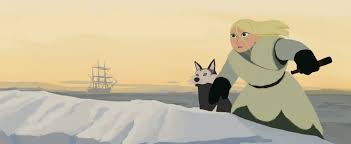
1882, Saint Petersburg. Sasha (voiced by Christa Théret), an adventurous fifteen year old Russian aristocrat, is haunted by memories of her grandfather (Féodor Atkine), a renowned explorer who disappeared on an ill-fated expedition to the North Pole. When her father tries to marry her off to the arrogant, scheming Prince Tomsky, Sasha's refusal to back down over her grandfather's fate results in a public spat that leaves the family in disgrace. Faced with angry parents, unsympathetic to her goal, a sad but determined Sasha runs away from home. She heads to the Great North where hard work and pluck eventually land her a spot on a ship captained by the hard-bitten Lund (Loïc Houdré). Along with Lund's roguish first mate and brother Larson (Rémi Caillebot) and Tom (Thomas Sagols) the affable cabin boy, Sasha undertakes a perilous journey through the ice flow and glaciers to prove her grandfather's ship made it to the North Pole.
Released in a vintage year for animation the Franco-Danish produced Tout en haut du monde (The Entire North of the World), re-titled Long Way North, struggled to make an impact on the English market. Which is a crying shame because it remains something special. Richly detailed with painterly visuals and faceted characterizations on par with the best live action fare, the film boasts a unique period setting, exquisite 2D animation that evokes the paintings of Henri Matisse and Paul Gauguin, and a plot that recalls Jack London, Jules Verne and the rich tradition of French adventure fiction. Amidst a market bustling with occasionally identikit 3D computer animated fare, first-time director Rémi Chayé works hard to give his film a distinctive, handcrafted identity.
As so often with such picaresque adventure stories the journey proves more important than the destination. Scripted by two women, Claire Paoletti and Patricia Valeix, the film resists portraying Sasha as an instant proto-feminist badass. Instead it acknowledges the hardship, suspicion and prejudice a young woman would face while undertaking such a perilous journey and makes them plot points. Gradually the sheltered rich girl grows and adjusts to her tough new world, initially under the tutelage of kindly barmaid Olga then later under a succession of mentors from Lund and Larson to the clearly smitten Tom. Enduring the taunts and sneers of other uncouth sailors, Sasha perseveres through numerous set-backs and hardships, learns new skills (e.g. how to tie a knot quickly which saves lives during a storm) and eventually earns their respect. Torn between tomboy dreams and gender constraints of the nineteenth century, Sasha emerges a textbook example in how to construct a gutsy, engaging young heroine.
Compared with the helter-skelter pacing of much contemporary animated fare Long Way North tells a more elegant, almost classical adventure yarn. Yet it is one full of intrigue and excitement with impressively visceral, realistic set-pieces (the ship trapped by a collapsing iceberg), well-crafted relationships (the fraternal tension between Larson and Lund is especially well handled) and moments of surprisingly harrowing drama. Perhaps unsuitable for very young viewers, this is an animated film where you feel the bone-chilling blizzards that beat down the characters and where no-one is good or evil but behave harshly or kindly depending on circumstance. If the inclusion of one contemporary pop number sits uneasily with the impeccable period visuals, a testament to the Chayé's command of the medium is that the climax plays out as a wordless montage over the end credits yet proves thoroughly affecting and powerful.