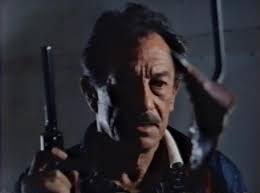
Two courting couples unwisely sneak on board an old shipwreck. In the midst of getting amorous they are savaged by a pair of vicious doberman dogs, then stabbed to death by a blade brandishing maniac in a giallo-esque black hat, trench-coat and leather gloves. It is but the latest in a string of grisly murders that prompts ageing macho Sheriff Bob (Mario Almada) to team with his brother: ageing macho naval patrol captain Roy (real-life sibling Fernando Almada) to catch this killer. In the meantime the mad murderer's blood-lust claims the lives of numerous 'wayward women' then imperils Bob's wife Joan (Cristina Molina).
Clearly the American slasher craze of the Eighties worked its way down to Mexico. Filmed in the most southeastern city in the United States: Brownville, Texas, La Muerte del Chacal (Death of the Jackal or The Jackal Murders) has monolithic Mexican screen idol Mario Almada, the Latin Charles Bronson, headline his own 10 to Midnight (1983). Famed for his so-called 'righteous vengeance' films, Almada grimaces as convincingly as his north of the border equivalent as a late middle-aged, granite-faced tough guy. Even though cigar-chomping Sheriff Bob does a piss poor job stopping the slash-happy maniac murdering 'loose women.' Mere moments after Bob visits a topless bar to glean information (yeah right, good excuse), a stripper is butchered in her dressing room. Later he inadvertently provides the killer with his next victim by inviting the vivacious Sally (Olivia Collins) to a party, after which she inexplicably insists on visiting that same creepy shipwreck. Evidently because grisly murder sites make her super-horny. Uh, okay. As with the majority of slasher films the underlining message is a woman's unchecked libido will inevitably seal her own doom. Even the film's one strong, proactive female character: the policewoman (Lizetta Romo) who poses as a hooker to trap the killer winds up reduced to a sniveling victim.
If La Muerte del Chacal stands guilty of rehashing the most tiresome, misogynistic clichés of the American slasher film it does stand out in some areas. For one thing the killer's identity is revealed at the midway point and proves a genuine surprise. His use of vicious dogs is also an interesting and nasty touch although animal lovers may find the scene where Bob bashes one doberman against a wall more unsettling than the murders. In a genre more often dominated by teenagers here the characters are amusingly all middle-aged: the men all swarthy, mustachioed and macho, the women straight out of a Latin tele-novella with copious mascara and enormous hair. Once the killer is caught the film abruptly jumps five months ahead. It sidesteps the more interesting emotional impact of his identity to dwell on more conventional suspense scenes where he menaces Bob and Joan. Screenwriter Gilberto de Anda lifts the usual post-Psycho (1960) 'mommy issues' to provide the skimpiest psychological rationale ("That man is a bomb that could explode at any minute" remarks a helpful psychiatrist) for the killer's homicidal impulses but the emphasis on family loyalty presumably resonates with a Latin audience.
The eerie intro shows Pedro Galindo III, son of Mexican screen idol Pedro Galindo, can milk an atmospheric location and stage a competent suspense sequence with prowling P.O.V. shots, fish-eye lenses and shadowy cinematography. Alas, thereafter the film grows increasingly plodding, repetitive and derivative. Galindo lifts a famous scene from Mario Bava's pioneering Five Dolls for an August Moon (1969) when Sally stumbles onto a storage locker full of hanging corpses. He then drags things past the confrontation between killer and cop to end on a shock that combines the ambiguous coda to Halloween (1978) with the dream sequence from Dressed to Kill (1980). Not the worst slasher film by any means but neither is this especially distinctive. The ambiguous ending led to a sequel.