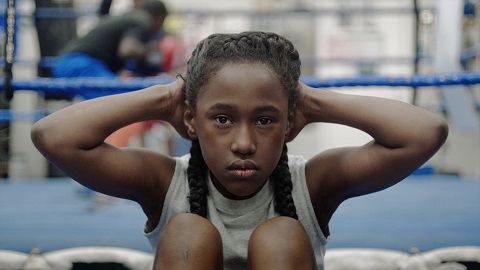
Toni (Royalty Hightower) is an eleven-year-old girl who has been something of a loner, preferring to train as a boxer in her spare time away from school, under the tutelage of her older brother who likes to encourage her to keep physically fit. But one day, after the usual training, she is wandering the corridors of the community centre waiting for her brother to finish up and she hears music, so takes a look at where it is coming from. It is in the main hall, where a large group of girls, some her own age, some older, are crowding around two others who are having a dance-off, and Toni is immediately intrigued: should she continue her boxing or join the gang who are preparing for a dance contest?
The issues of fitting in at a crucial stage in your development were no strangers to the movie world, especially the indie movie world, and director and co-writer Anna Rose Holmer here chose a path very well travelled by other filmmakers, especially female filmmakers who often found the lure of adolescence as a subject matter too much to resist. Indeed, it was becoming quite the cliché that if you were a woman directing a low budget effort, then young girls would be your focus, be that as audience or as what your story would be about, though whether young girls actually wanted to see them was a different matter.
In this case, Holmer did not quite emerge from the ranks of her contemporaries, mainly thanks to the British director Carol Morley having made The Falling which took a very similar subject and did her own thing with it. The trouble with that was that if you had seen one you might not bother watching the other, though they were both equally of interest in their own way and on actually experiencing them you would see there were similarities, yet also differences that marked them out as their own entities. They did each keep the reason for their most dramatic tricks a mystery, leaving them deeply symbolic of some rite of passage or other that was specific to the young girl who led the narrative.
Hightower was the discovery here, playing it self-possessed so that we would often be wondering what was going on in her head since she was not in the habit of opening up about her feelings to the other characters. When she did allow us a glimpse of her inner life, it was more in her deeds than her speech, such as when she pierces her own ears as her mother (who goes completely unseen throughout) would not have allowed her to do so, suggesting her teenage rebellion phase is just around the corner. Yet Toni seems to wish to reject that as well, if only to make sure she is her own person and not beholden to her peers who she joins in the dance troupe in a move to fit in during the early stages of the plot, even though we can perceive a personality that will not enter so easily into that arrangement.
Does Toni really want to be part of the group, is she an individual in her own right, or can she find a third way? The fits of the title saw the older girls begin to collapse for no reason anyone could see, they would recover afterwards and be fine, but our heroine is sceptical as to the benefits of the process, despite the apparent social standing it gives the sufferer as having been through some form of initiation to womanhood, such as menstruation (which is alluded to only obliquely). Not that she wants to stay a little girl forever, it's just that she wants to grow up on her terms, and falling over while shaking and staring into space does not appear to be her idea of a great method of doing so. Will Toni experience this or will she avoid it? The ending was ambiguous as what we see may well only be occurring in her mind, but it was a memorably odd conclusion that opened the door to Toni's maturity. That Holmer allowed the girls in her cast a lot of control over the direction the film took gave it a richer tone, and Danny Bensi and Saunder Jurriaans' soundtrack was off kilter enough to offer a surreal mood, but at just over seventy minutes you could be forgiven for finding it slight.