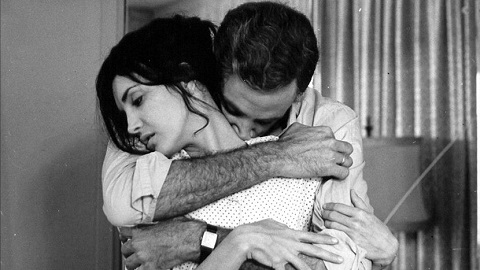
Havana, Cuba, 1961, and there is an exodus of the locals from the island nation now the revolution is clearly there to stay, with many of those from the bourgeoisie deciding they have had enough and it is time to leave their homeland to the Communists. However, not all of them are moved to go, there are those who elect to stay such as Sergio (Sergio Corrieri), a middle class property owner who has seen off his ex-wife and parents at the airport today and returns alone to his apartment to consider his next move. On the other hand, he could simply busy himself doing nothing in particular as he has done for most of his life, so sceptical is he that the revolution will summon significant change...
This film made its director, Tomás Gutiérrez Alea, the most famous in that field of creativity from Cuba, and was the first of his works, of any kind of Cuban movies for that matter, to secure distribution worldwide. He was a supporter of the revolution but that did not mean he could not express some cynicism about it, and how his fellow citizens would not be feeling a massive benefit after the Batista regime had been ousted in favour of the Castro one, with the point of view that there was always room for improvement uppermost in his mind, and indeed the mind of his shiftless protagonist. Whether Sergio essentially embodied his surrogate was a matter up for debate, however.
In fact, it was difficult to truly pin down Alea's feelings towards his lead character for there were points here where he was making a lot of political and social sense in his observations (he narrated throughout), whereas at others he just came across as a womanising creep out to exploit the supposedly newly-liberated Cuban female at every turn. These actions come back to bite him before the end of the film, which cut off just as the Cuban Missile Crisis hit the region, apparently because we were well aware of how that turned out and that the world was not destroyed in a nuclear holocaust; the strategic importance of his little island home was not lost on Alea, but he was looking at the more intimate picture as well.
Some call Memories of Underdevelopment, adapted from the novel by his countryman Edmundo Desnoes (who co-wrote the screenplay with the director), the Cuban Hiroshima, Mon Amour, since that Alain Resnais film was a major inspiration for the team behind it with its mixture of documentary footage and a romance that will not last in the current world situation, and if you had seen that previous effort you might find this one's adherence to Resnais' techniques and form a little lacking in comparison since the cynical may observe this was more a pastiche than an original work. But all that said, Alea did conjure up a significantly vivid sense of place for his drama, be it from the location shooting or that feeling his characters were drawn whole from life rather than derived from his imagination.
As for that romance, it was a bit dodgy, really, as Sergio is out looking for an attractive woman to seduce soon after the mass departure and settles on a young girl named Elena (Daisy Granados) who is seeking a role in the film industry, the director seeming to be writing from experience there, though you would hope not too faithfully as once Sergio has the girl in his bedroom, we discover the reason for her panicked reaction straight after the deed is done: Elena is only sixteen years old. This unlovely development brings about the set of circumstances where the formerly pessimistic Sergio has his belief in the benefits of the revolution affirmed at last when he is taken to court by Elena's horrified family, though you would have to admit he did actually have sex with this girl - he is over two decades older - which renders this plot mechanism not as entirely cheering as we were possibly intended to find it. If you could cope with that, there was a lot to recommend here, mostly in its richly evocative "you are there!" atmosphere rather than its didactic moments. Music by Leo Brouwer.
Aka: Memorias del subdesarrollo
[No extras on Mr Bongo's Blu-ray, but it does present the restoration which is the best this has ever looked.]