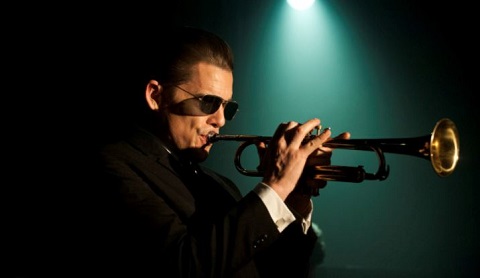
Chet Baker (Ethan Hawke) is a famed trumpet player who specialises in jazz, but the trouble is he also specialises in being a heroin addict. He remembers being at a club where he was the headline act, and he got through his set with ease, but backstage he had caught the attention of a woman who introduced him to the drug, and that led to a lifelong dependency on the substance. But as he was spread-eagled on the couch in his dressing room in the arms of this woman, his girlfriend barged in and demanded to know what he was doing, and why he was going off the script, to which he pointed out he was a far younger man when he became an addict anyway, so he is allowed to improvise a little...
If that opening was bringing back bad memories of Kevin Spacey's Bobby Darin biopic Beyond the Sea, rest assured it was not that much of a vanity project, but you might have applied that suspicion to the writer and director (and dedicated jazz fan) Robert Burdeau who apparently believed his beloved Chet Baker did not have an eventful enough life to translate to the screen, so basically made up a different one for his film. This was a trend that some identified as proof biopics were going downhill (it was released within months of Don Cheadle's Miles Davis riff Miles Ahead), but it was really an appropriation of the methods of bringing musical talents to the big screen that had been the norm for decades.
Which was to say, messing around with the true story was more often a habit with the movies than it was an aberration, there had to be some concessions to crafting what was expected in entertainment, so cast your mind back to Cary Grant playing Cole Porter in Night and Day and you'd see an account that was factually hopeless and simply an excuse to string performances of Porter's work together. That was pretty much what you were offered here, a trumpeter called Chet Baker whose life story had a glancing recognition with the facts laid down in the cult documentary Let's Get Lost of a good few years before, and even that film had its critics who claimed it leaned closer to hagiography than was necessary.
They got the heroin right enough, to the extent that the narcotic was depicted as the driving force in Baker's existence, though it had a rival in Jane (Carmen Ejogo), the great love of his life. Only it didn't, because there was no such person as Jane, she was Budreau's invention to turn this into a rather hackneyed yarn of a tortured genius and the woman who tried to keep him straight. You could only wonder why these choices were made, as they merely misinformed those new to Baker, and those who were dedicated fans (he did court that kind of obsessive appreciation) would be driven up the wall by all these liberties taken with their hero. Some would be more willing to forgive for the sake of a movie that at least brought their idol back into the spotlight, if you could hear their praise over the general grumbling.
Hawke had long since proven himself a boon to indie moviemaking of all varieties (OK, maybe not YouTube videos), and he brought his accustomed dedication and sincerity to a role he had coveted for some time, even doing his own not bad at all approximation of Baker's singing voice, though he mimed to the trumpet melodies. Ejogo too was a professional presence, sustaining interest in what quickly lapsed into cliché, a fractured relationship with his parents here, the problems with the law there, and the love of a good woman he may well reject for his dedication to the needle. If it was the music you wanted, at least that was served up with utter respect, and the production obviously relished recreating smoky jazz clubs and recording studios alike, though there was a sense of the greatest hits about the choices. However, Baker was turned into a travelling hippy in a camper van for a considerable stretch of the film, not unlike the Bobby Darin biopic, which felt like a different story to what the jazz should have been conjuring up. Slick, but hard to entirely endorse.