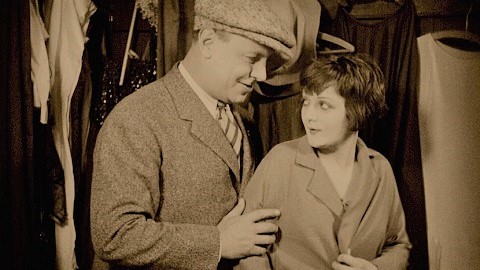
In this prison, one of the inmates is called to see the warden, who informs him of his wife and child's desire to see him again, and they have sent him their best wishes, but still after all this time inside he refuses to discuss the reason he committed his crime, much less exchange any words at all. But on the warden's coaxing, he now begins to open up about what landed him in jail, though he must go back to the time he was a carnival barker known as Boss Huller (Emil Jannings), working with his wife (Maly Delschaft) who he had recently had a baby with. He was in charge of the beauty parade of distinctly non-beauteous employees, but one day a teenage orphan arrived with instructions for Huller to look after her...
A fateful meeting, for he takes one look at her nubile form and is immediately thinking he would be better off with her than his wife, who herself cannot help but notice she now has a rival who is considerably more desirable than she. Such was the premise of circus drama Varieté, considered an instant classic when it was released back in 1925, but whose star fell over the decades for a variety (hah!) of reasons. One of those was the leading man, as Jannings famously was allied strongly to the German Nazi Party, and as the nineteen-thirties went on he was increasingly vocal in his support. Couple that with changing tastes in acting styles, largely because when the silents were superseded by the talkies a change was necessary, and Jannings was yesterday's man as the war years ended.
He did enjoy one major, worldwide hit when you could hear his voice, and Varieté was an obvious precedent to that fashion for moral melodrama: The Blue Angel, though that had the effect not of giving his career a huge boost into the sound era, but of making a star of Marlene Dietrich, who was the protégé of the director Josef von Sternberg and would go on to conquer the globe with her inimitable approach to vamping. Even today, she looks captivating in her best films, but Jannings remained too close to the silents, and as you watch him here you can understand why he was better suited to that facially expressive acting; his Boss Huller was still a rather curious choice from a modern perspective.
That was mainly down to his profession in the plot, where you could well believe he had been a big noise in the trapeze business some time before, but now had become older and out of shape, which added a dash of hypocrisy to his chasing after the young woman Bertha-Marie. She was played by Lya De Putti, possessor of quite a life, albeit a short one, born into Hungarian nobility, married at age thirteen, two kids soon after, then decided she wanted to be an actress, a film star indeed, which she almost succeeded in here, though her career faltered as the talkies appeared on the scene. Soon after, she was dead thanks to complications from getting a chicken bone stuck in her throat, a curious and sad way to go for a lady who was only in her early thirties at the time. Delschaft did better, but was always a nearly woman when it was she who was up for playing the Dietrich role in The Blue Angel.
Anyway, you get the idea, Huller is a hasbeen on the circus act circuit until he is rejuvenated by Bertha-Marie, all very well until we jump forward to see one of its genuine stars in Artinelli (British actor Warwick Ward whose suave demeanour is applied to caddishness) has lost his trapeze partner in tragic circumstances, but when he sees the young woman he has a brainwave and invites both her and Huller to appear with him. Here's your sticking point, twenty-first century, as this leads to the worst stunt double ever for Jannings was a portly gentleman by this stage yet we were asked to believe he was the same muscular fellow who athletically takes to the air above the audience. It's so blatantly a different person that it does take you right out of what is a fairly absorbing tale of good people gone to the bad, but there were compensations, chiefly director Ewald André Dupont and cinematographer Karl Freund's way with the camera, a combination of the strikingly innovative and the atmospheric. Nobody was going to mistake Varieté for anything remotely contemporary a century later, but as a sensation of its day, much-censored for its content, it was full of interest.
[Eureka's Blu-ray features the carefully restored print assembled from multiple sources to get the very best results. You also have the choice of three (count 'em!) soundtracks.]