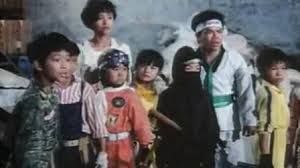
One summer feisty Little Chilli (Chiao Pei) rounds up her childhood friends Fatty (Yang Wei-De), Bumpkin (Hsu Yu-Ta), Little Elf (Lin Tung-An), Hsiao-Mao (Chang Chai-Ming) and Two-Teeth (Wang Chi-Cheng) to greet their pal Rocky (Cheng Wei-Pai) when he flies home from the United States. When Rocky treats the kids to a slap-up meal at a fancy restaurant, Chilli stumbles onto a robbery-murder. A dying man entrusts Chilli with a valuable diamond asking her to pass it on to his partner, Helen Ching (Siu Hung-Mui). The only clues he gives to her identity are that she will be wearing a flower and has a mole on her upper thigh. As the kids bumble into one mess after another in search of the elusive woman, an evil one-eyed gangster (Choi Chung-Chau) has his clumsy but brutal thugs dog their every move. What they don't realize is these seemingly ordinary children are in fact the Seven Lucky Stars, a badass bunch of super-skilled kung fu kids no crook would ever want to mess with.
Child acrobats and martial artists have been a staple of Chinese circuses and Peking Opera shows for centuries despite their ethically dubious training methods. The appeal of such stage acts crossed into movies including the Japanese Watari Ninja Boy (1966), Shaw Brothers' oddity Demon of the Lute (1983) and numerous Taiwanese fantasies like The Dwarf Sorcerer (1974), Silver Maid (1970), the hugely popular Hello Dracula franchise and the Shaolin Popeye films that caught on in the mid-Nineties. This sub-genre truly exploded in the Eighties with veteran schlockmeister Chu Yen Ping's Young Dragons: Kung Fu Kids (1986) which spawned three sequels. The Hong Kong produced Lucky Seven was something of a cash-in yet achieved greater notoriety than its progenitor overseas leaving cult film fans in Europe and the US shocked and amazed at the wince-inducing slapstick fu feats performed by its cast of pint-sized Jackie Chans. Or in child actress Chiao Pei's case: a junior Moon Lee.
Sure, Macaulay Culkin doled out his fair share of cartoon sadism in Home Alone (1990) but he was never on the receiving end. In Lucky Seven the child actors not only dole out but wind up taking an alarming level of punishment. What's more they do so for real. That really is sweet little Chiao Pei, Cheng Wei-Pai and company performing those spin kicks and back flips, taking punches and flying face first through a glass window! In some countries such reckless endangerment could be justly classified as child abuse. At the same time there is no denying the remarkable skill displayed by the accomplished juvenile cast in executing these outrageous stunt sequences. Combined with dynamic editing the action in Lucky Seven is exciting, memorable and unlike anything else in international cinema.
Though director Chiu Chan-Kwok exhibits scant skill when it comes to endearing his tantrum-prone child heroes to the audience the performers themselves are quite personable. Sadly none of them graduated to adult stardom although co-star Siu Hung-Mui (who also performs many grueling fight sequences) had some minor success. Chiu Chan-Kwok's other films include the notable horror comedy Ghost Bustin' (1983) though he later switched to softcore porn and has been inactive since the Nineties. Actor and stunt coordinator Yau Ying-Hung continued to stage action for films like Dragon Ball: The Magic Begins (1991) which shares a similar live-action cartoon tone. He was also active as a screenwriter penning, among others, the sequel Magnificent 7 Kung Fu Kids (1989) prior to his lone directing gig: the trashy, super-low budget Tricky Guys (2000).
Lucky Seven functions as a pint-sized parody of Sammo Hung's hugely popular and influential ensemble kung fu comedy: My Lucky Stars (1985). It both co-opts and parodies several of the earlier film's gags and plot motifs. Yau Ying-Hung mimics the Jackie Chan style with sight gags and stunt sequences that hark back to silent comedy. However, Lucky Seven also lifts conceits ideas like the bike chase from BMX Bandits (1983), kids adopting Thirties gangster garb from Bugsy Malone (1976), a captive bonding with a mentally-handicapped criminal as in The Goonies (1985) and an imaginative child thrust into a dangerous conspiracy a la Cloak and Dagger (1984). Indeed the film bolts wacky family-friendly slapstick humour onto a dark crime thriller where the violence is played deadly straight. The gags frequently border on the surreal and more often than not fall flat. Take the bizarre, borderline offensive scene where the kids recoil from an ugly transvestite as he/she recreates Kelly LeBrock's intro in The Woman in Red (1984) complete with Stevie Wonder's 'I Just Called to Say I Love You'! On the other hand Chiao Pei's body-popping dance-off against a disco show-off to the sound of Wham's 'I'm Your Man' is a charming high-point. The film's purloined soundtrack is a jukebox delight including choice samples of John Carpenter's theme for Halloween (1978), Madonna's 'Material Girl' and 'Burning Heart' the song Survivor performed for Rocky IV (1985).
If the humour is alternately mawkish and crass once the action kicks in the stunt-work is fast, furious and fun. The finale alone features punch-ups, explosions, Sam Peckinpah-style slow-motion violence, glass shattering stunts and a bone-crunching face-off against two western martial arts experts (including trash ninja film regular Eugene Thomas) who pull no punches. One kid even kills a guy with a sword!