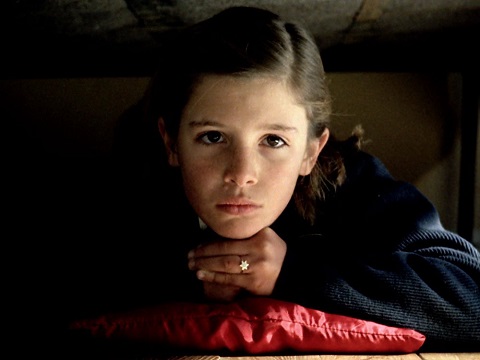
Estrella remembers back in 1957, in the rural home of Northern Spain where she grew up, the morning when she woke and became aware that her father Augustin (Omero Antonutti) was never going to return to her and her mother (Lola Cardona). She knew this because as she rose from her bed, she noticed a small, cylindrical box under her pillow that she realised contained his pendulum, the one he would use for dowsing which had brought him a small income when he was not attending to the community's medicinal needs. She remembers further back than that, and of how her father was a loving man but distant, as if he was struggling with some inner turmoil that he would never share...
The first thing you have to know about writer and director Victor Erice's El Sur is that while viewers have pored over its meaning ever since its initial release back in the mid-nineteen-eighties, it was not necessarily intended to be such a puzzle. What happened was that he had planned to make a third act where he would explain precisely what had befallen to Agustin when he was in the South of Spain, but the money ran out (or was denied) and this was never completed. Therefore all those theories of what he had been so tormented about (and Antonutti conveyed a quiet, deep sadness that spoke volumes without getting into actual specifics) would have been unnecessary if the production had been finished.
Nevertheless, this air of mystery did lend proceedings such a haunting quality that it stuck in the memories of those who saw it, since there seemed to be an aching melancholy in Estrella's life that she was trying to salve by going back over her memories, played by two actresses, Sonsoles Aranguren (who went on to a career specialising in post-production effects in television and film) aged eight, and as a teenager Icíar Bollaín (who continued to act but then branched off into direction, including the acclaimed Even the Rain). Although these two did not resemble each other to any great similarities, you tended to forgive the conceit since the difficulty to pin down the past was a major theme.
Both for Estrella and Agustin, as they both are affected by something in their formative years that we find out about for her, but are not privy to with him. The manner in which an event in the past, traumatic in this case, can echo into the present and forward into the future and thereby shape each individual down the generations was a strong one, and made sense even when El Sur was perhaps vaguer than it really needed to be. It was part of a long tradition of European films where directors would fret over childhood, their own and others, and use that as a prism to examine what had gone before and how it influenced the character of one person or indeed a nation. Some have posited Agustin's heartache was connected to the fascist government that Spain was afflicted by for decades, and had emerged from about five years before this was made.
What we do know is that Estrella is so intrigued by her father's moods that she turns detective and endeavours to pin down what it is that so damaged his soul, though the further she investigates the bigger the story becomes (a film star, a lost love, a threat?) until she cannot manage it without actively going to the place of Agustin's origin in the titular South and delving into the answers that way. Whether that is a good idea or not was up to the audience to decide, as the more she worries over the problem the more all-consuming it becomes - for her father as well as herself. The benefits of uncovering pretty much everything that has blighted the lives of yourself and your loved ones were subtly considered, as Erice could not present anything without that careful style, though he only made one other fictional feature, the equally well-thought of Spirit of the Beehive which also depicted the unknowable elements of a child's world; here we were invited to contemplate how that question can grow to dominate the memories of the adult mind. Good thing or bad thing? Frustratingly, we are not offered a definitive conclusion from El Sur. Music by Enric Granados.
[The BFI's Blu-ray features a restored print, looking very nice too with all those shadows, and has a featurette on Erice and an interview that plays over the film as extras.]