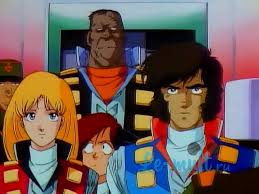
While on holiday at a tropical paradise planet, intergalactic troubleshooter Joe (voiced by Hiroshi Takemura) and his team of 'Crushers' receive word of an urgent mission. An orbiting space prison built on an ice asteroid has been knocked out of orbit and about to fall onto the planet Kirius. So Joe and his crew: beautiful tomboy space princess Alfin (Run Sasaki), bionic tough guy Talos (Kiyoshi Kobayashi) and hyperactive kid Ricky (Noriko Ohara) take charge of the space armada in co-operation with operations director Hume (Iemasa Kayumi) to rescue the stranded convicts. Yet it turns out most of the prisoners are political dissidents imprisoned for opposing Kirius' dictator Gellstan (Yuzuru Fujimoto). The Crusher team discover they have been set up to take the blame for an 'accident' that will conveniently wipe out Gellstan's enemies.
Five years after Crusher Joe (1983) the second anime adapted from Haruka Takachiho's series of science fiction novels was released direct to video. Which marked neither a drop in popularity nor quality for in Japan in the 1980s the market for so-called original animated videos or OAVs was thriving. From the cataclysmic intro to the spectacular starship combat that concludes this tightly-plotted, pulse-pounding space adventure, the animation upholds the high standards of Yoshikazu Yazuhiko's original theatrical feature. The layout and designs are flawless while the fluidity of the animation stands as a testament to the artistry of Japanese animators throughout this golden age of anime.
Yet for all the myriad visual pleasures in Crusher Joe: The Ice Prison it is really the script that marks it as something special, with its lively characterizations (each team member has a rounded personality both vivid and compelling), snappy dialogue and economical but ambitious plot. The core concept underlining Crusher Joe melds the space opera action of Star Wars (1977) with the 'rescue team' theme of Gerry Anderson's much beloved 'Super-Marionation' Thunderbirds. Both series and spin-off movies were very popular in Japan and influential. In fact Anderson's creation sired an official anime spin-off: Thunderbirds 2086 (1982) (known as Technovoyager in Japan) although the Crusher Joe adventures updated the formula in a far more accomplished manner. As with Thunderbirds, Crusher Joe emphasizes scientific solutions to life-threatening situations. Trapped aboard an ice prison plummeting towards certain doom, Joe calls on all his ingenuity and pluck to rally the panic-stricken prisoners together in order to escape. Despite the brief running time the adventure is grand in scope and spectacle yet also mounts a nuanced, ambitious story that takes in politics and satire.
A theme runs throughout detailing the tension between the brash, outspoken but idealistic young rescue team and the scheming, manipulative establishment that do not hesitate to scapegoat them as the perfect patsies when the mission goes awry. This cross-generational conflict reflects lingering resentment over the Second World War along with the growing confidence of Eighties bubble economy fuelled youth. Ironically, as some might argue, this generation were destined to be betrayed again when Japan's economy tanked in the Nineties. Again themes of cross-generational conflict, betrayal and resentment were revisited in later anime from Hayao Miyazaki's Oscar-winning Spirited Away (2001) to the phenomenon of Eden of the East (2009). Between high-octane action sequences Crusher Joe: The Ice Prison mounts fairly sophisticated satire proving there is more to this series than interstellar shoot-em-ups, though it has plenty of that too. Joe and the gang returned one last time in Crusher Joe: The Ultimate Weapon - Ash (1989).




 Display comments