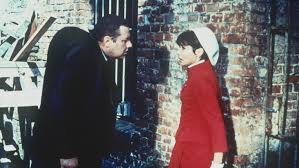
Judging from the many Edgar Wallace 'krimi' films that feature Soho in the title (eg. The Phantom of Soho (1964), The Gorilla of Soho a.k.a. The Gorilla Gang (1968)), Germans were as fascinated with its seedy reputation as Brits were with 'permissive' European cities like West Berlin, Paris, Stockholm or Amsterdam. The Hunchback of Soho opens exactly as a horror movie should: a sexy blonde in a bikini and trenchcoat runs through the London fog before being strangled to death by a maniacal hunchback. With dead girls piling up the Fleet Street press reckon they have another Jack the Ripper on their hands. Bumbling Sir John (Siegfried Schürenberg) of Scotland Yard assures them he has his best man, Inspector Perkins (Günther Stoll) on the case. Pipe-puffing Perkins takes note how each of the victims have soft white hands that suggests they were handling soap detergent.
Meanwhile across town winsome heiress Wanda Merville (Monika Peitsch) learns she has inherited a significant fortune as a lost relative of the aristocratic Perkins family. As bumbling, nearsighted lawyer Harold Stone (Joachim Teege) reads from her father's will, he is spied on by his sexy but shifty secretary Emily. She makes a mysterious phone-call. Thereafter Wanda is abducted by the slobbering hunchback and brought to a grimy, gothic women's prison. Strapped into a torture chair and threatened with a blowtorch poor Wanda meekly suffers along with the other girls imprisoned by suave sadist Alan Davis (Pinkas Braun) and his whip-wielding lady conspirators. The inmates face the choice of either toiling in misery at a laundry mill or else slut it up in fishnet body-stockings for patrons at a seedy Soho club. In the meantime Inspector Perkins and Sir John visit kindly Lady Marjorie Perkins (Agnes Windeck), her eccentric husband General Edward Perkins (Hubert von Meyernick) and their nephew saintly vicar David only to find the bad guys have replaced Wanda with a sultry imposter (Uta Levka, future star of Carmen, Baby (1967) and Scream and Scream Again (1969)).
Taken individually the Edgar Wallace krimi films offer delirious, inventive pulp horror thrills. Yet viewed collectively one can see the series continually recycled familiar motifs: the endangered heiress, hulking henchman, a women's prison, mysterious murders, posh families with secrets to hide, even the whole laundry angle. Fans of the German-made series often maintain the films were never quite as good once they switched from moody black-and-white to garish colour. While not entirely true (later entries College Girl Murders (1967), Angels of Terror (1971) and The Man with the Glass Eye (1969) all have a great deal to offer) there is no denying Hunchback of Soho suffers many niggling flaws that dilute its strengths. Alfred Vohrer's expert direction ensures things rattle along nicely, delivering all the requisite thrills, gags and titillating moments even though the plot is all over the place. Its chief flaw relegates series staples Sir John and Inspector Perkins to bumbling buffoons, routinely flummoxed at every turn. The villains are ultimately undone less through solid detective work than their own tendency to bump each other off. On top of that Harry the hunchback exhibits a perplexing level of cunning and homicidal mania against his own employers that is only explained towards the end.
While it initially looks like the resourceful captive women will prove as instrumental in cracking the central mystery as our Scotland Yard sleuths the film has a frustrating tendency to establish vivid, spirited, intelligent female characters then bump them off. Among their number is a plucky character played by Ilse Pagé who went on to become another series staple as Sir John's flirty secretary Miss Finlay. Pagé acquits herself well in a somewhat meatier role. As does co-star Suzanne Roquette as the equally plucky Laura who strikes sparks with Inspector Perkins as a club girl whose bravery also seals her doom. Interestingly Hubert von Meyernick, who went on to inherit the role of inept but affable Sir John, also essays a more shaded role here. His Colonel Blimp-like character comes across like a German attempt to satirize the archetype of the stuffy, self-important British military hero. If Hunchback of Soho suffers from an uneven narrative it nonetheless hails from a point when the series' formula of camp comedy mixed with comic book horror was still good fun. Along with a suitably gruesome fate for the chief villain the film throws a neat twist towards the end. This was the first Edgar Wallace krimi filmed in colour although despite a brief glimpse of Piccadilly Circus in all its glory the bulk of the action was clearly shot on a German sound-stage. Music by Peter Thomas with a great scream-stomp-and-grunt jazz theme.