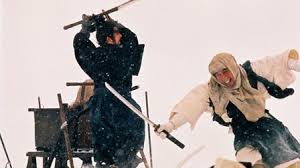
Having outwitted and slain every assassin sent by the Yagyu Clan, fugitive samurai turned killer-for-hire Itto Ogami (Tomisaburo Wakayama) and his infant son Daigoro (Akihiro Tomikawa) prepare for a final showdown with the evil Lord Retsudo Yagyu (Minoru Oki). With no other warriors left in the clan, Lord Yagyu tasks his youngest daughter Kaori (Junko Hitomi) with killing Itto but even her deadly knife-juggling skills prove no match for the Ogami's gadget-laden baby cart. In desperation Yagyu turns to his illegitimate son Hyoei (Isao Kimura), an embittered, mountain-dwelling mystic with an arsenal of black magic spells and nasty psychological tricks.
The sixth and final film in the Lone Wolf and Cub series released by Toho replaced original director Kenji Misumi with Yoshiyuki Kuroda. Originally a special effects wizard at Daiei studios, Kuroda created puppet creatures for the influential friendly ghost opus One Hundred Monsters (1968) and directed its outstanding sequel: Yokai Monsters: Spook Warfare (1968). While the Lone Wolf and Cub films always had a semi-fantastical tone, Kuroda drew this entry deeper into the supernatural, crafting pyrotechnic set-pieces (this time the death-dealing baby cart comes equipped with an unlikely but irresistibly outrageous machinegun!) and pitting Itto Ogami and son against an actual wizard. Cackling, cave-dwelling creep Hyoei worships the old forest gods and practices black magic. At one point his spell brings a trio of shaggy samurai back from the dead as scary zombie warriors.
In contrast to the almost serene Buddhist-Shintoist philosophy espoused by the series amidst the extreme crimson carnage, Hyoei's powers stem interestingly from bitterness and resentment. Whereas our hero Itto Ogami aims to transcend his life of vengeance and blood, Hyoei seemingly seeks to vent his rage at being abandoned by his father as a child through psychologically torturing victims, slowly draining them of hope. Throughout White Heaven in Hell, Hyoei tortures Itto by murdering any innocent person unfortunate enough to cross paths with the Lone Wolf and Cub. He and his sneaky ghouls then taunt Itto from their secret hiding place. It is an interesting change of tactics for the villains in this series although the story suffers one notable flaw. Unlike the Zatoichi films compassion for innocent ordinary folks was conspicuously absent throughout this series. White Heaven in Hell registers the shock of each horrific death but as portrayed by the unflappably stoic Tomisaburo Wakayama, we have little sense Itto is moved or unsettled in any way. Kazuo Koike's original, sprawling, one hundred and ten volume gekiga (manga aimed at adults) makes each of Itto's adversaries the subject of lengthy chapters that function as character studies. In adapting his work for the screen Koike condenses his work. As a consequence the film breezes through each episode rather drastically so Kuroda can get on with staging the next amazing action sequence. Kaori and Hyoei barely get enough screen-time to make an impact while the plot also trots out yet another Yagyu sibling, Azusa (Chie Kobayashi), for a typically kinky twist mixing sex and sadism.
Nevertheless the concluding chapter underlines that Koike's saga is really about a cycle of familial destruction and rebirth. Yagyu destroys Itto's family so he in turn sparks a chain of events that destroy the Yagyu clan. Fittingly White Heaven in Hell closes on an unsentimental yet tender moment between father and son, emphasizing the series core strain of gloomy romanticism as the duo endure and their fight with the Yagyu clan rages on. While Kuroda does not share Kenji Misumi's gift for striking visual symbolism his film is no less pictorially extravagant. The vivid cinematography by Chishi Makiura imbues the action with an hallucinatory quality akin to a fever dream. Vast snowy wastes provide a spectacularly picturesque backdrop, particularly in the memorable finale where Itto and Daigoro face what seem like a hundred ninjas on skis. Like the abundant death-dealing gadgets it is a sequence closer to a James Bond movie than a typical chanbara. Also worth savouring is Kunihiko Murai's fantastically funky score which is heavy on the wah-wah guitars.
Interestingly in contrast to their cult notoriety in the west, these six Lone Wolf and Cub produced by Zatoichi actor Shintarô Katsu as a star-making vehicle for his brother Tomisaburo Wakayama (it worked: Wakayama won the Nippon Academy award shortly afterwards for Under the Cherry Blossoms (1975)) are all but forgotten in Japan. This is largely due to the Lone Wolf and Cub television series that premiered a decade later. For the Japanese audience the show's star Kinnosuke Yorozawa is the definitive Itto Ogami while Wakayama's tenure in the role is but a footnote at best. Yorozawa reprised the role in four spin-off features films throughout the Eighties. However, Tomisaburo Wakayama made a return to the series this time as the evil Lord Yagyu opposite Hideki Takahashi as Itto Ogami in Lone Wolf and Cub: Assassin on the Road to Hell (1989). Controversially, Takahashi managed to do what Wakayama could not throughout his six film run: kill Lord Yagyu. Purists allegedly preferred the big-budget Lone Wolf and Cub: The Final Conflict (1992) with Masakazu Tamura as Itto even though it strangely does not feature the famous baby cart.