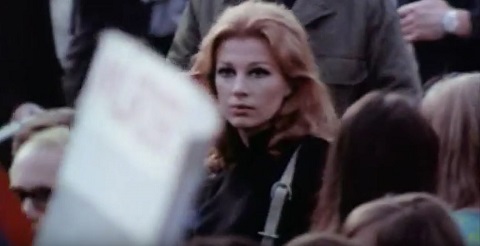
Barbara (Anita Sanders) is driven up to this London park and gets out of the car as the driver asks her if she wants him to pick her up later. She is noncommittal, and as he leaves she begins to cast her eyes around to take in the sights of people getting up to all sorts of things: there's a band in the large tree over there, playing a song, various old folks are relaxing on the grass, some younger people are fondling one another and taking their clothes off, and so on. Indeed, one naked woman is being carried on the shoulders of a naked man as they wander around the trees. But Barbara decides to head for the city, and is immediately taken with an American man (Terry Carter) who likewise notices her; however, she is white and he is black...
Should that be a problem? Of course not, but in the late sixties this was a bold statement on a subject that had been taboo up till just recently, which may make you believe that Nerosubianco, also known in English as Black On White, was a brave exploration for its time examining romance between the races. Then you would note the co-writer and director was Tinto Brass, one of Italy's leading sexploitation producers, and you began to have doubts as to its political sincerity and more suspected that he was relying on shock value and plentiful nudity to get the punters in, blatantly using sex as a way of hyping up his material and making a tidy profit. There in a nutshell was the dilemma moviegoers had about watching what seemed to be conscience-raising.
Brass had certainly done his homework about the hot button topics of the day, and that showed in every frame, yet that suspicion he was a cynic who would have included any old nonsense if he thought it improved his commercial prospects was hard to shake, especially when you would be aware he was setting out his stall as a future manufacturer of what he liked to call erotica, but what his critics would term soft porn. But were the trappings of those efforts necessarily exclusively lubricious and would they never allow anything more serious-minded to become clear? When Radley Metzger, himself at the high end of erotica, presented this film he retitled it The Artful Penetration of Barbara.
Which did not exactly offer much hope that it would be anything other than a bunch of naked people and simulated sex, yet say what you like about Brass's proclivities, he did have an eye for the striking image, and the visuals here were light years ahead of much of what was on its way as far as depicting sex on the screen went. Not that you would learn very much from the countercultural concerns displayed here, as montage was the director's preferred method, a representation of its lead character's mental journey as she flits from one thought to the next, unsurprisingly returning to the carnal over and over, but also with musings on the Vietnam War, the place of advertising in society, and that racial element that saw future TV star Carter (the original Colonel Tigh on Battlestar Galactica) as the embodiment of a contemporary issue.
Rather than an actual person, but more or less everyone here was representational of something or other, even the contemplative and lustful Barbara. Every so often what narrative you could discern would wander off on a tangent such as flipping through footage of war atrocities, then the next minute we would see Sanders getting 'em off in a graveyard (this appears to have been shot in Winter, so well done Anita on your iron constitution), and then the band, The Freedom, would pop up once again, placed in the action to play one of their songs, be they up that tree or naked and body painted or perspiring in a sauna surrounded by bare naked ladies. You may have considered this was created to be enjoyed under the influence of mind altering substances, or it actually had been created under the influence, but you could watch it stone cold sober and appreciate Brass's talent for keeping you engaged with his pictures even as you were sceptical he was quite as connected to the world he was commenting on. It was a strange experience, all over the place really, yet captured something of the era almost despite itself.