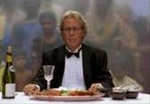
In 1967, filmmaker Jørgen Leth made a film called The Perfect Human, a short, quirky examination of what it means to be human, from eating to existing in a body. This is one of controversial film director Lars von Trier's favourite films, and so in 2001 he decided to offer Leth, his mentor, a challenge: remake the film five times, using five obstructions devised by Von Trier. Leth accepted.
The Five Obstructions is part documentary and part game show, with the prize being Leth emerging with his integrity intact. It's also very amusing to watch as von Trier devises conditions that home in on Leth's weak spots and try to trip him up so that he unintentionally makes "crap". The first obstruction is that he must remake The Perfect Human using only twelve second cuts, with a voiceover providing answers to the questions posed in the original, in Cuba (because Leth has never been there before) and with no sets. This he does, and very successfully too, so it's satisfying to witness Von Trier foiled at the first hurdle.
However, things don't go quite as well for the next obstruction. Von Trier believes Leth is too distant and dispassionate about his subject matter, so makes him go to the place on Earth that he considers the most miserable, which in Leth's experience is the red light district of Bombay - not only that, but he must play the central character himself. What starts out as a potentially harrowing ordeal turns almost inspiring as Leth films himself shaving and eating before the destitute people of the area, all who gather round to watch and appear in the film behind a large screen. So what's wrong with that?
Von Trier didn't want anyone seen in the film apart from Leth, that's what, so although he acknowledges the quality of the work, he feels he must punish the director for the next obstruction. Either return to Bombay and film it again against a blank screen, or do anything he wants with the film, that is, there is no obstruction. He takes the latter option, but without his challenge, Leth seems lost at first. Nevertheless, a film arises, and a more overtly sexual one at that, but tellingly it is the least effective.
So far so good, but von Trier wants to back his friend in to a corner this time and orders him to work in a medium they both despise - animation. "I hate cartoons," Leth mutters, his previously good humoured stoicism showing signs of cracking as von Trier says he wants him to be floundering like a tortoise on its back. But what he comes up with could be the most imaginative of the lot, resembling Richard Linklater's film Waking Life and certainly the most visually striking. Von Trier is almost ready to admit defeat.
One more obstruction remains, and it is that von Trier will direct the film but place Leth's name on the credits as director, with his only contribution being to read out the voiceover. It is here the documentary draws to a satisfying conclusion as von Trier recognises that the obstructions simply made Leth all the more creative, and if anyone has been shown up by the exercise, it is its instigator rather than its "victim". It's entertaining to see the impish von Trier's imagination exposed and failing to make a dent in Leth's composure, and what could have been a spectacularly pointless film offers a valuable insight into how restrictions can test the limits of creativity for the better. Well, Leth's creativity at least.
Notoriously eccentric Danish writer, director and producer, a graduate of the Danish Film School, who has capitalised on international acclaim and disdain in equal measure. Thrillers Forbrydelsens Element and Epidemic started the ball rolling, with distinctive war drama Europa really setting von Trier up as a talent to watch.
Breaking the Waves, the first in a series of victim stories, won the Grand Jury Prize at Cannes and his fame spread, especially as he had teamed up with three other directors to create the Dogme '95 rules of filmmaking - controversial The Idiots was von Trier's result. Then Dancer in the Dark, a musical starring Bjork, proving he was anything but predictable, and Dogville, a scabrous attack on American small town life.
He was next involved in The Five Obstructions, a documentary which revealed much about his methods. Then, a thematic follow-up to Dogville, slavery drama Manderlay, which was followed by little seen comedy The Boss of It All and most controversially, his relationship goes to hell horror Antichrist.
His drama Melancholia won its star Kirsten Dunst Best Actress at Cannes, but he was ordered to leave after a press conference faux pas, then returned with the patience-testing, two part Nymphomaniac. After a gap, he made bleak horror comedy The House That Jack Built, to more controversy. On television, he created the superb horror series The Kingdom, and he frequently casts Udo Kier.