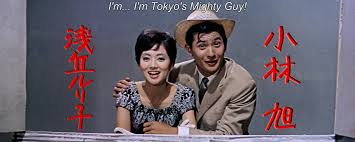
Newly returned from Paris, rugged and headstrong young Jiro (Akira Kobayashi) is set on opening a French restaurant in Tokyo's Ginza district. So set he fails to notice his childhood gal pal Hideko (Ruriko Asaoka) is hopelessly in love with him even though she is engaged to another man. When boorish retired prime minister Mr. Ippon'yari (Toranosuke Ogawa) crashes his car into the restaurant Jiro goes looking for restitution only to clash with a yakuza gang called the Typhoon Club running a protection racket. Impressed by Jiro's two-fisted resolve, Ippon'yari promptly pays to rebuild the restaurant while gang leader Senkichi (Hiroshi Kondo) repents his sinful ways to become his sous-chef! Though our hero's troubles are far from over he finds there is nothing that can't be resolved with wit, gumption and some hearty punch-ups with a few songs along the way.
Japan's Nikkatsu Film studios remain infamous for their so-called Roman Porno line of glossy sexploitation films that began in the Seventies and continue to this present day. Yet back in the Fifties and Sixties the studio were known primarily for their youth-oriented action films. Audiences flocked to these slick Technicolor concoctions that came across like cockeyed combinations of film noir, campy James Bond-style action-adventure romps and Elvis Presley-style pop musicals showcasing the top youth idols of their day. In Tokyo Mighty Guy the idol in question is Akira Kobayashi, looking leaner and more fresh-faced compared with his rugged, super-cool turn in Black Tight Killers (1966), hitherto his most widely available vehicle in the west.
A delightful An American in Paris (1951)-style musical opening credit sequence, with Kobayashi singing a jaunty tune while strolling with his lovely co-star Ruriko Asaoka through a cardboard cut-out facsimile of Paris, signals the lighthearted tone. Prior to Japan's obsession with anime films like Tokyo Mighty Guy functioned like live action cartoons delivering comic book thrills, action and comedy along with a tune or two. Yet despite the candyfloss surface director Buichi Sato – who went on to tackle the disparate likes of Lone Wolf and Cub: Baby Cart in Peril (1972), the Sonny Chiba time travel actioner Time Slip (1980) and Ninja Wars (1983) pairing Chiba with superstar Hiroyuki Sanada – laces the film with a surprisingly sardonic sense of humour. The plot has a strong element of social satire pitting Jiro against pompous politicians, ambitious gangsters and self-serving businessmen. Throughout his misadventures our hero uncovers a cycle of poverty, desperation and exploitation involving a shady alliance between big business and organized crime.
For all its surface gloss and deceptively wholesome, family-friendly atmosphere, Tokyo Mighty Guy contains certain elements more conservative minded Japanese viewers and critics found seamy and unpalatable while others relished the sly satire. Take for example the subplot where Jiro helps a happy hooker evade three clingy clients or when he is drawn into the tragic life of bespectacled cutie Toshiko who attempts suicide after her chubby, wealthy lover dumps her for another woman. While its plot is undeniably amorphous and skips wildly from one tangent and schizophrenic mood shift after another, Tokyo Mighty Guy remains thematically consistent with a sprightly anti-establishment tone. In fact the finale draws all the tangled threads together in satisfying fashion. Saito laces the film with plenty of wacky, borderline surrealistic comedy, the songs are very pleasant indeed and the easygoing chemistry between Kobayashi and Asaoka packs plenty of charm.