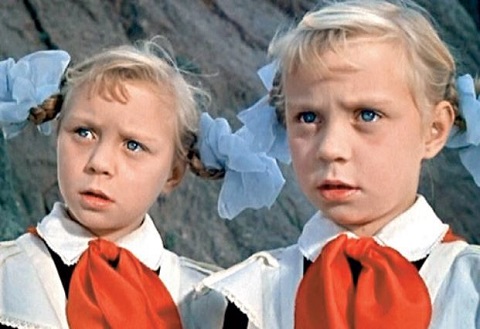
Olya (Olga Yukina) is a little Russian girl who has spent the evening with her fellow children sneaking a look at the film playing at the local cinema, which has been rated for over-sixteens only. Once it finishes, the kids run away so they do not get caught, but Olya gets her apron caught on a nail and tears it. To make matters worse, as she returns home a black cat crosses her path: she is very superstitious so barks and spits at it to make it go away. Once back in her apartment that she shares with her grandmother (Tatyana Barysheva) and a few pet animals, she is told by her that she looks a state, and sure enough when Olya looks in the full-length mirror her face is dirty, soon remedied by a cold wash. But keep an eye on that mirror, it's not all that it seems...
The United States had its Westerns, but the Soviet Union had its fairy tales - okay, and its war movies - but what gathered more of a cult following were those curious, frequently surreal fables filmed by the major studios for the duration of the Cold War, and World of Crooked Mirrors was one of those. They may not have had the funds available to them that those imperialist running dogs of capitalism enjoyed across the Atlantic, but they made up for that by making the most of what they did have, and that was an abundance of imagination, along with a liking for a magpie-like appropriation of other works that would feed into the fantasy landscapes they were creating for the mass audience.
Therefore this example started off with a magic mirror much as in Alice Through the Looking Glass, then took a turn into a variation on the 1939 touchstone The Wizard of Oz as Olya must go on a quest once she is in the mirror world, though she never complains that she would prefer to return to her grandmother. She meets her reflection, Aylo, played by the actress's twin Tatyana Yukina (they would both die in their fifties some forty years later and only made one further film together), who she becomes fast friends with as she guides Olya around this strange world which in typical fairy tale fashion involved a kingdom where the desire for the throne was set to plunge the place into disarray, especially when the King (Anatoli Kubatsky) is a fool.
Was this actually a work of propaganda? Did the mirror world represent the madness of the Western world that little Olya could regard with a jaundiced eye, knowing her nation had a far more sensible method of organising itself? You could certainly read aspects of a political bent to the depiction of what was undesirable, for example the King's Dancers are dismissed for jiving to the crude approximation of rock 'n' roll as a bunch of loafers and idlers, but these details felt more incidental than the impetus for telling the story, which appeared to be more to entertain the younglings rather than indoctrinate them. Director Aleksandr Rou pretty much exclusively created these fairy tales throughout his career, and you had to assume he had some affinity with flights of fancy.
Oh, and that quest? Somewhat arbitrarily, our heroines stumble upon a worker in the mirror factory who refuses to comply anymore, and is beaten for his trouble, then chained on top of a rock that is guarded by stern soldiers who will only let you by if you have the key. The girls call him Friend, which is pronounced backwards as everyone's name in this realm is, and make up their minds to prevent his execution by grabbing the key from the throne room, which proves easier said than done, involving dressing up as boy pages and various mishaps such as falling of a mile-high cliff (!) - and surviving. The adults were often representing animals such as a weasel, rat, kite or toad, all spelled backwards, and those higher up the social ladder were either more corrupt or more idiotic than the simple peasant folk, so perhaps there was a bit of politics inherent here after all, but the bright colours and cluttered sets were ensuring you could just as easily watch this as pure escapism and not allow the indoctrination to get to you. Such oddities as characters singing the tune of "Who’s Afraid of the Big, Bad Wolf?" only contributed to the zestful strangeness. Music by Arkadi Filippenko.




 Display comments