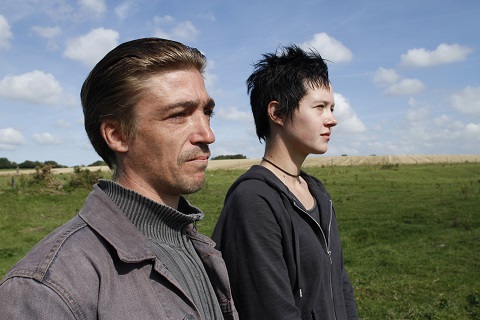
A drifter (David Dewaele) fetches his sandwich from a generous patron and approaches the day, seeking to be at one with nature as the sun rises over the French countryside, but also to team up with a local girl (Alexandra Lemâtre) who has sought him to help her with a troubling issue she has lived with for many years. They walk around the landscape, contemplating what they are about to do, then the drifter takes a rifle and waits outside the girl's farmhouse home. When her father appears, he fires off a shot, killing the man instantly, thus achieving revenge, or at least satisfaction, for all the time he has abused his daughter. She then goes to console her regretful mother (Sonia Barthélémy)...
Enigmatic was the word for Bruno Dumont's distant fable about a man who appears to be Satan in modern guise, but may be, you know, "outside" Satan, as the title would indicate. Quite what that meant appeared to be an excuse to stage various blankly curious scenes interspersed with lots of shots of those rolling hills, seemingly yet another of those movies where directors exercised their opinion that the rural areas were hotbeds of twisted behaviour, a loose genre that had been around since the nineteen-sixties, if not longer, though the picturesque photography element had been less of a concern for, say, yet another adaptation of The Hound of the Baskervilles before that era happened along.
Credit where credit was due, Hors Satan was certainly an attractive film to look at, when the characters were not getting murdered that was, but the drifter (nobody was given a name here) is such a force for upset that he cast a pall over the whole experience, as you assumed was the general idea. Initially you think he and the goth girl he performed that favour for are boyfriend and girlfriend, but later that does not come across as the case; they certainly like each other, and he does her another even bigger favour later on, around the dramatic climax, but other than that they appear to be platonic in their relationship, no matter that she does try to playfully kiss him at one stage.
But perhaps because he is an otherworldly being in human form he is not interested in such a connection, though that was not to say he had no interest in the pleasures of the flesh, as there was a sequence in the final hour where he meets a hiker and before you can say Jack Robinson she has given him a beer, whipped off her clothes and commenced intercourse - only his sheer force of will causes her to suffer a fit. Then again, he does perform an exorcism on a teenage girl at the behest of her fretful mother, though how she knew about his powers, how anybody knows about his powers really, remains one of the film's mysteries. There were no special effects, however, it was important to say, so this was no horror film though it might fit awkwardly into the realm of religious fantasy if it was classifiable at all.
Needless to say, this probably makes Hors Satan sound a lot more eventful than it was, as much of the running time was taken up with the drifter wandering around, sometimes accompanied by the goth girl, sometimes not, sometimes on some errand or other, then again perhaps not. He does exhibit what may be jealousy when another guy tries to muscle in on his occasional companion, and this chap seems blameless, or certainly not deserving of what the drifter does to him, but too much of this was rather smug in a way that informed us we were not to reason why he was committing these acts for they were beyond the ken of us mere puny mortals. That Dumont was the mortal, puny or otherwise, who had devised the whole shebang suggested a very high opinion of his own material, though if you don't blow your own trumpet maybe nobody else will, which left us with a conundrum that failed to clear anything up, the cinematic equivalent of seeing patterns in the clouds only to discover those clouds had been caused by arson smoke.