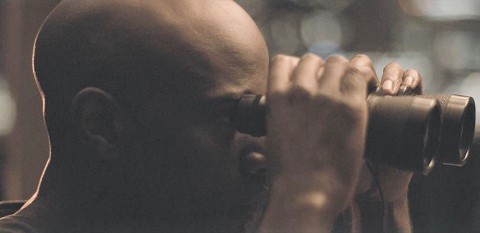
Andrew Deeley (David Gyasi) is a music journalist who lives alone in a London apartment, not exactly by choice, but he is as comfortable as he can be seeing as how he is a severe agoraphobic thanks to a violent incident in his recent past where he was the victim. He is still not over this personal nightmare, though he is able to hold down his job since he can be paid for conducting and writing up interviews over the telephone as well as penning his original articles, and his boss is very understanding. But while Deeley is extremely wary of human contact, he cannot deny that he is lonely, especially for the company of the opposite sex, an impulse he is fuelling by spying on the woman (Yennis Cheung) who stays in the flat in the tower block across the way...
He even uses binoculars to keep a check on this woman, that's how dedicated he is to watching her, and one night it seems as if she has spotted him and is staring back, suggesting a connection in Deeley's mind that may not actually be there. If this is sounding familiar, then Alfred Hitchcock's Rear Window was consciously evoked with the very adept Gyasi in the James Stewart role, but there was a twenty-first century twist in that citizens are becoming more isolated thanks to a fear of crime and a preoccupation with technology keeping us apart. How? That's because with more and more people living their lives online, they become a profile on a webpage rather than meeting for proper conversations and socialising.
The sense that these innovations are distancing us more than they bring us together ran through Panic, which may be inaccurate in some ways, after all now you could discuss subjects with people across the world without having to leave your sofa, but in other ways struck a chord as you could understand how online interaction encouraged the voyeur in us all. You could in theory track an individual through their days and nights without them being aware that was what you were up to, indeed they need never know that you were examining the minutiae of their lives so closely, and that creepiness was very much a part of writer and director Sean Spencer's tone here. Was Deeley someone who elicited pity, or was he someone more dangerous?
In truth, that question was never quite resolved, and though his obsession with the neighbour does get him out of his flat, it does not necessarily bring him to good places. What happens is that he plucks up the courage to go on a dating website, or rather a website where you can hook up with strangers for sex, and along comes "Michelle" (Pippa Nixon) who spends part of the evening with him. It would have been the whole evening, but after they do what comes naturally she picks up the binoculars and spots the lady across the way being attacked and kidnapped; Deeley sees none of this, but cannot persuade her to go to the police since she prefers to be anonymous even in this face to face situation, and off she escapes into the night without so much as a thankyou, well and truly disturbed by the disquieting turn events had taken.
Not as disturbed as Deeley, however, as his fixation on the woman who was apparently abducted grows ever fiercer, so much so that he manages to leave his home and break into hers, where he finds signs of a struggle and a little information about her, who turns out to be a Chinese immigrant called Kem. Armed with an address (and a hammer) he adopts the role of detective, the fantasy of a knight in shining armour saving the damsel in distress a very potent one in men who do not entirely have a realistic grounding in their existence. So is our hero a force for good in the murky world of human trafficking or is he merely a nuisance in over his head, someone who should have stuck with going to the police with his concerns rather than endeavouring to fix this dilemma himself? Again, Spencer left this up to us to decide, and offered either side of this conundrum, with Deeley both innocent victim and violent aggressor, all because of his bolstering self-image of a protagonist the real world is not exactly going along with. Its ambiguous conclusion lingered in the mind with a strong, if basic, musing over the place of masculine pride in a changing (eroding?) social landscape. Music by Christopher Nicholas Bangs.