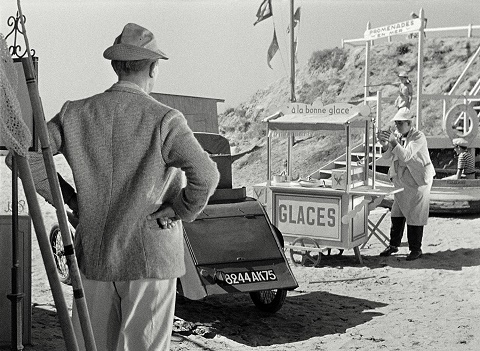
It is the summer in France and time for the nation to leave their lives behind for a week and visit the beach. Some go by train, others by road, but they all get there eventually to soak up the sun and enjoy the fresh seaside air, including Monsieur Hulot (Jacques Tati), who putters down the country lanes in his tiny car even as more powerful vehicles leave him behind in a cloud of dust. When he does reach his destination, a small beach hotel overlooking the coastline of the West, his fellow holidaymakers are present as well, but they may not be prepared to share their vacation with this eccentric gentleman who has a habit of leaving a degree of chaos in his wake, entirely unintentionally...
Director and co-writer (with Henri Marquet and other contributions) Jacques Tati had already enjoyed a worldwide hit with Jour de Fete when this, his most famous not to say celebrated work was released, and continued his technique of creating a comedy that while it had words, was mostly indebted to the silent movie humour that was so lauded and respected around the time this was made (words did not matter as much as sound effects). He had a history in clowning, but while he was not above the broad slapstick there was always something a little more subtle about why Hulot and his world were funny, you were invited to observe these folks and seek out their idiosyncrasies rather than have the jokes served up to you on a plate.
For this reason Tati can divide audiences between those who embrace his generous yet quirky stylings, and those who hear the words "French comedy" and believe it to be a contradiction in terms, but they would never be receptive to this sort of japery anyway, which although he is highly admired in his native France, simply translated to a cult following elsewhere on the globe, even in those regions where this film was one of the biggest international hits this country ever enjoyed. His approach did go out of fashion, certainly, yet watching this now that essential nostalgia for a place far in the past merely adds a poignancy to the proceedings, particularly the final scenes when the holiday draws to its natural conclusion.
But before that we have the memories of what a time we had with Monsieur Hulot, as his film was a lot like leafing through a collection of old holiday snaps and wondering at the attitudes and ideas of entertainment at the beach would customarily entail. As Tati's efforts wore on through the following decades, he became ever more the perfectionist, to the extent that he would tinker with this, his undoubted classic, never happy with what he was crafting and in danger of overthinking that section of the entertainment profession he had made his specialist subject. But the personality of Hulot never changed, inasmuch as we could discern it: he was such a hard to pin down chap that even when we can tell what he is thinking, as when he runs away after creating minor mayhem, his largely non-speaking escapades are a pleasant conundrum.
He was both a simple man seeking simple pleasures in life, yet given to erratic flights of fancy, and when those two aspects collided the results could be hilarious. There were select characters who understood Hulot and his purpose in their lives, and in this case that would be the elderly Englishwoman (Valentine Camax) who remains charmed by him when others are not, and the most attractive holidaymaker, the young lady (Nathalie Pascaud, a non-actress pal of Tati's who he cast on a whim) who befriends him, but is never going to be anything but a platonic acquaintance. Again, we cannot tell if Hulot would have liked a dash of romance on his vacation, but little moments dotted around the film such as that only deepened what was at heart a very silly film. The gags, of which there were many, were not always immediately blatant, but when you relaxed into the rhythm of the piece you would find yourself laughing out loud at Hulot's unexpectedly ferocious tennis game, or the details such as the exercisers frozen in a pose until the angle changes and we see their instructor has been distracted by our hero. An absolute delight. Sunny music by Alain Romans.




 Display comments