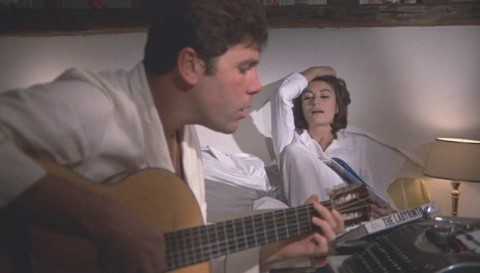
Anne Gaulthier (Anouk Aimée) sees her young daughter on weekends when she visits her at boarding school, taking her out on day trips and making the most of their time together. She is not the only parent who does so, and another is Jean-Louis Duroc (Jean-Louis Trintignant), who sees his young son, but their paths have never crossed until now. One chance meeting later, and he is driving her home through the French countryside where they discuss each other's lives, she revealing that her husband died not so long ago, leaving her unable to look after their daughter alone, and he that his career as a racing and test driver means he cannot look after his own son either. So much in common...
Is it any wonder that romance is in the air, in one of the most stylish French films of the nineteen-sixties? It was director Claude Lelouch's first big hit, and struck gold internationally, winning the Best Foreign Film Oscar for its year and seen across the globe by audiences who wanted to dip into that particular chic that it conveyed so well. But the acclaim was by no means universal, for as soon as it picked up attention that dreaded phrase "style over substance" was being landed on the movie, with the naysayers pointing out that there was barely enough plot to fill ten minutes of screen time, never mind an hour and three quarters. However, cinema is about the moving image and being captivated by that, and most were indeed dazzled.
Another comparison that would come up in discussion of A Man and a Woman, or Un homme et une femme if you preferred the original title, was to the then-novel concept of the Sunday newspapers colour supplements, those pull-out sections that made the most of the new availability of colour photography to bring the best definition in that format to the readers of the broadsheets. Obviously there were magazines offering the same thrill, but these papers managed to keep the cost of a potentially pricey subscription down and lend it a more mass market appeal; nowadays when colour photography is a given and black and white is all but a relic except for the occasional spread, the novelty has worn off long ago.
Yet Lelouch would switch his scenes from monochrome to full colour and back again throughout, for no other reason than it looked attractive and kept things visually interesting, a technique that re-emerged infrequently, but was most obviously used to its best effect in Lindsay Anderson's If…. a couple of years later, though he claimed his budget forced him to use whatever film stock he had to hand, and it was not a fashion statement. Lelouch most assuredly was making a fashion statement, with the elegant Aimée and the ice cool Trintignant a perfect couple for that superficial approach, their characters falling in love but most importantly looking good doing so, with hardly anyone else of significance in the plot to distract either us or them from their romantic goal, aside from perhaps the kids.
That most exciting of sixties occupations, the racing driver, ensured that Lelouch had ample opportunity to include many an action sequence as Jean-Louis went about his job, zooming around at high speeds in a variety of slick vehicles, test driving the best sports cars and taking part in Le Mans, making this a surprise entry in the decade's cinematic fast cars obsession for it was as much interested in the need for speed than it was in the love affair. It also offered the illusion of the story in forward motion when it was actually rather static and even complacent, but Francis Lai's insistent music on the soundtrack was as much a contributor to that as well (though British viewers may be taken out of the driving sequences when they notice that piece was used as the theme tune to long-running current affairs programme Panorama). Building to a final note of uncertainty that was resolved in the belated sequel A Man and a Woman… Twenty Years Later, this cast an undeniable spell in a way that the most fashionable artefacts of bygone ages can do, so much so that any more depth would have been unnecessary.