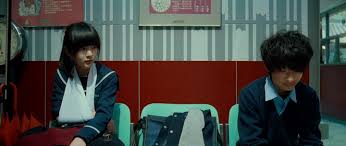
Mei (Xu Jiao), a sad and lonely thirteen year old girl with an active imagination, indulges in wild flights of fancy to escape the reality of her parents' (Rene Liu and Harlem Yu) crumbling marriage and grandfather's (Kenneth Tsang) failing health. She grows fascinated with the new kid at school, a shy and sensitive boy named Jay (Hui Min-Lin) with a secret past and artistic talent that sadly makes him a target for bullies. One day when bullies ambush Jay in an alley, Mei comes to his aid. The pair strike up a firm friendship and explore their shared passion for nature and art. When Mei's grandfather takes a turn for the worst and her parents are about to split up, she impulsively leads Jay on an adventure through the woods in search of grandfather's cottage.
A moving and magical film with impeccably crafted storybook visuals, Starry, Starry Night uses fantasy and special effects to tell a grounded human story in a deeply affecting and poetic way comparable to the thematically similar Bridge to Terabithia (2007). Like that Disney movie this Chinese-Taiwanese co-production adapts a much-beloved children's book, in this instance one by writer and illustrator Jimmy Liao. Liao has a large fan-following in Asia and seen his work adapted for the screen before with Joe Ma's Sound of Colours (2003) and Turn Left, Turn Right (2003) by superstar directing duo Johnnie To and Wai Ka-Fei. Yet whereas those films spun their own stories from the source material, Starry, Starry Night wisely approaches Liao on his own terms and succeeds magnificently.
A scene in which a schoolteacher remarks that by interacting with others we can better understand ourselves establishes the central theme. Yet as events unfold we see this is easier said than done. Mei's parents retreat into their private worlds to cope with their personal pain. Mei's mother, an art dealer constantly on the phone with a French client, yearns to escape into a dream of a chic Parisian lifestyle. In one memorable moment she drunkenly goads her daughter into re-enacting the iconic dance sequence from Jean-Luc Godard's Bande à Part (1964), a scene that goes from charming to tragic in the blink of an eye. In their determination to preserve Mei's childhood innocence, her parents leave her lost and confused by adult emotions. However, as with Bridge to Terabithia, Starry, Starry Night posits art and fantasy as both a refuge for alienated youth, a bridge that enables people to understand each other better. It is also a source of strength for those coping with the emotional disconnect too often felt in life. Dwelling in each other's fantasy worlds and sharing their artistic obsessions enables Mei to realize Jay has it worse than her in a lot of ways. Gradually she builds the emotional maturity to cope with loss and value what she has left.
For Mei's Amelie (2001)-like flights of fancy, Taiwanese auteur Tom Lin, working with American cinematographer Jake Pollock, melds practical effects with digital wizardry. Scenes such as the fight where Mei imagines her shadow takes the shape of a giant rampaging kaiju or where she and Jay are followed by a menagerie of origami animals symbolizing their blossoming creativity and friendship prove enchanting. The most elaborate sequence has Mei and Jay aboard a flying train that soars into an animated recreation of Vincent Van Gogh's painting 'Starry Night' which inspired Liao's book. Yet the filmmakers take care not to drown in whimsy nor an over-abundance of special effects. Each fantasy sequences stems from a very palpable and affecting emotional place. While suffused in the warm glow of the Christmas season with numerous seasonal imagery, the film has an underlining melancholy making it clear these characters might be dreamers but are also deeply troubled. Lin pulls off the unique trick of making the film seem both stylized and realistic by grounding his bravura cinematic flourishes in human behaviour. For example, a domestic argument becomes a near-operatic set-piece akin to a Brian De Palma thriller, wherein Mei watches a goldfish bowl tumble in slow-motion leaving the poor fish flapping on the floor. To counterbalance the CGI, Lin also makes stunning use of rarely seen Taiwanese scenery throughout the third act that finds our young runaways lost in the woods. What starts as a tranquil, magical setting slowly takes on a more ominous atmosphere reflecting their journey through darkness and uncertainty towards greater maturity and understanding.
In lesser hands the central relationship could come across as cloying. Thanks to Lin's delicate direction and the affectless, subtly nuanced playing of the young leads it is deeply heartwarming. Newcomer Hui Min-Lin makes an impressive, quietly charismatic debut while seasoned child star Xu Jiao continues to develop as one of the most exciting, compelling, understated yet expressive young actresses in Asian cinema. She shoulders most of the 'heavier' drama yet does so without milking our sympathy in any cutesy child actor way, but with utter conviction and sincerity. Refreshingly the filmmakers avoid a pat happy ending in order to teach a deeper lesson with an ambiguous coda set in Paris many years later that, depending on your inclination, can be interpreted as either bittersweet or romantic.




 9 (from 1 vote)