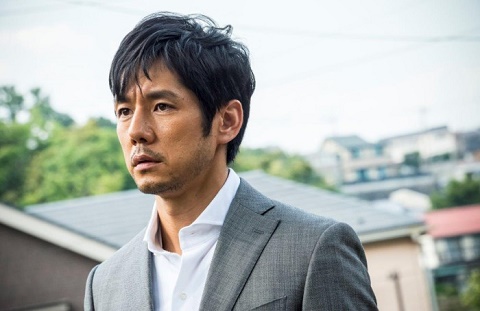
Detective Takakura (Hidetoshi Nishijima) was wondering for some time whether he really had the same enthusiasm for his job as he had before. One incident pushed him over the edge to rejecting the whole profession: at the station where he worked, there had been the murderer of eight people in an interview room and he was supposed to be speaking with him. He had been quite charmed by this man in spite of what he had done, and as he went out of the room to collect his thoughts he discussed him with his partner, but then calamity struck as the psychopath broke free, killing one of the officers and taking a woman hostage. Takakura tried to negotiate with him, which saw the woman murdered and himself seriously wounded...
Well, it would put you off police work if that had happened, wouldn't it? But even though he leaves it behind and sets up a job lecturing at the local university, the nastier elements refuse to dissipate; he makes the mistake of trying to investigate a mysterious disappearance of almost an entire family from a few years ago, which draws him back in, much as if Creepy, or Kurîpî: Itsuwari no rinjin if you spoke Japanese, had been one of those Scandinavian crime dramas that viewers the world over loved to watch on television. But as it progressed, it was clear this was nothing of the sort, it was more a grim examination of how the pressure of a powerful personality can manipulate others into committing terrible acts.
The sticking point was whether this was pure conjecture, or whether the most easily led in the world were able to throw away any compunction to morality and actually carry out ghastly crimes. The director was Kiyoshi Kurosawa, who alternated between quiet drama and strange horrors and thrillers with their particular meditations on the nature of evil; this was one of the latter, with shocking elements added in as the story carried on, especially in that second half. For that first, we had a drama that bordered on the soporific so carefully paced was it, gradually eking out the information to build up the picture of what precisely was going on, ultimately arriving at a conclusion that had some unpalatable things to say about what bad influences can have an effect on otherwise law-abiding citizens.
It took a cynical, bleak take on human nature when faced with someone who could easily get his own way when that meant sending out his otherwise innocent troops to be corrupted by evil and violence and do the corrupting in turn. Like tracking a virus back to its carrier source, the actual villain was perhaps none too well concealed, but you would be hard pressed to work out precisely what they were up to ahead of the revelation. With Kurosawa's emphasis on the ordinary to contrast with the extraordinary events it winds up depicting, much of Creepy risked appearing banal, and while that made more of a meal of the thriller aspect come the last half hour, it was an uneasy experience as you watched almost drama-documentary stylings get into more outlandish, near-horror territory.
One was reminded of David Lynch's mystery stories (plastic wrapping plays a role much as in Twin Peaks) with a touch of Michael Mann's Manhunter for good measure, where the normal life on the surface mostly, but not quite, concealed the Hell beneath that citizens were willing to ignore because they didn't wish to consider it was anything to do with them, never mind anything they could actually do to improve. That was in parallels, rather than in similarities of style, as Kurosawa kept his cool throughout, even as events were growing more sick and twisted that the reluctant sleuth would have ever conceived of, criminal experience or not. If finally, as a paranoid thesis on evil it was unconvincing and contrived, as a suspense piece it was not too bad in its post-Silence of the Lambs, murderous psychopath recast as super-powerful genius crime fiction manner. Really rather decent, in fact, if you could adjust to the deliberate forward motion to a worrying conclusion that you didn't have to be aggressively persuasive to craft victims; the bad guy was actually truly needling and pathetic. Sinister music by Yuri Habuka.