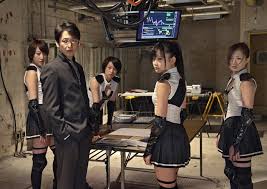
On an alternate Earth where nuclear weapons were banned Hiroshima, President John F. Kennedy brought the Cold War to a peaceful end and, most far-fetched of all, President George W. Bush achieved global harmony and was duly proclaimed greatest world leader of the century, the peace in Tokyo, Japan is shattered. Evil doppelgangers from our world arrive through wormholes to invade and terrorize. Posing as prominent political figures and celebrities they try to bring about an apocalypse. Safeguarding the citizens of Japan are the Danger Dolls: Arisa (Rumi Hanai), Rei (Rina Takeda), Miki (Kayano Masuyama) and Mari (Nana Seino), four sword-wielding super-heroines in matching mini-skirted uniforms. In order to keep their identities secret, the dolls go undercover as a J-pop idol group, the 'i.Dolls' (get it?). However, all is not quite as it seems. When Arisa stumbles through a wormhole into our 'imperfect' world, she realizes their leader, scientist Taichiro Yagyu (Kohki Okada) has not been entirely truthful with them.
Shusuke Kaneko, celebrated genre filmmaker behind the Gamera trilogy, Pyrokinesis (2000) and Death Note (2006) among many others, conceived the story and even wrote some of the pop songs for this energetic but confounding fantasy that cannot make up its mind whether it is a superhero romp, pop culture satire or bleak existential parable. Kaneko takes a needlessly oblique approach to melding a mind-bogglingly complex conceit to a plot that is really no different from any of the super sentai shows common on Japanese television. References to the 2011 earthquake and several fairly recent political scandals in Japan imply a certain satirical intent but the plot punctures that with several whiplash turns. Once Arisa happens across the Danger Dolls' counterparts on the 'real' world: a gaggle of giggly idol singers, the resulting inane antics bring things to a screeching halt. Kaneko caters to the fan-boy crowd with such tiresomely familiar tropes as up-skirt angles, hot-tub scenes and a vague lesbian subplot.
Things eventually take a wild turn when Arisa decides her life is a sham, tries to kidnap her look-alike and gets into a pointless fight with her fellow Dolls before the nihilistic kamikaze finale that remains quite unsettling despite the "it starts all over again" coda. On the positive side the action sequences are blisteringly paced and well choreographed. Kaneko occasionally overdoes the shaky-cam effect but the karate fights make admirable use of the actresses' natural athletic abilities. Rumi Hanai is a former rhythmic gymnast turned actress and model – previously in Kaneko's lesbian romantic drama Jellyfish (2013) – while Rina Takeda is a real life karate black belt who debuted with High Kick Girl! (2009) then continued in a similar vein with Karate Girl (2011) and Kunoichi: Ninja Girl (2011). More recently she appeared in Attack on Titan (2015) the live action feature film version of the multimedia phenomenon directed by Kaneko's regular special effects artist Shinji Higuchi. Interestingly, co-star Kayano Masuyama was a real idol singer as a former member of girl group AKB48. Which might be why the characters briefly slate idol singers as silly and fake then abruptly take it all back.
Regrettably the four heroines lack distinctive personalities. While the actresses excel in the action scenes they lack the skill and charisma to breath life into their one-dimensional characters. Far campier and goofier than much of Kaneko's early work, the film veers from silly to solemn in the blink of an eye, a trick other tonally schizophrenic Asian fantasy films have pulled off with far greater skill. The big plot twist also underwhelms and does not make much sense in hindsight given the mad science cult opposing the heroines seem thoroughly evil. Films as vapid and innocuous as Danger Dolls are dime a dozen on the low-budget end of the Japanese fantasy spectrum but one expects more from a filmmaker of Kaneko's stature and talent.