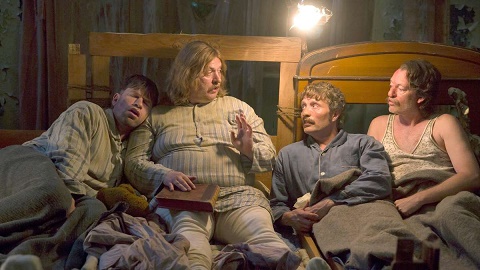
Brother Gabriel (David Dencik) and Elias (Mads Mikkelsen) are about to hear some sad news, but Gabriel, a university professor, gets the call first and dutifully rushes to his father's hospital bedside, just in time to see him expire, though he is retching into the sink when the old man goes. He calls Elias, who is at that moment masturbating in a toilet cubicle of a restaurant where he is on a date with a psychologist in a wheelchair who doesn't seem half as impressed with him as he is with her, especially when he tells her of his nightmare, his actual motive for the meal, where he attacks a large bird for refusing to hug him, which then turns into Gabriel, and then Elias rapes the bird. As you can imagine, these are no ordinary brothers... and there are more of them.
Writer and director Anders Thomas Jensen hadn't helmed a film for ten years when Men & Chicken, originally called Mænd & høns in Danish, was released, having spent that time as one of the most in demand screenwriters in Europe. When audiences saw what he had conjured up, the reaction was mixed, for while it was made with his customary skill and was obviously the film he wanted to create, there was a definite weirdness to it that many found offputting, and though it was billed as a comedy it was so deadpan in its strange events and twists that it was clear early on there was a specialist target for getting the most out of it. Basically, though it had some big Scandinavian names in the cast, it wasn't for everyone.
With all that in mind, if you got the joke, or found some humour in the messy plot at any rate, then you were going to get on with this well, and there were points where every so often you had been watching this wondering where the jokes were when suddenly it clicked and you would be laughing out loud. At times it was a curious exchange that was funny, at others it would be an item of physical humour that illustrated Jensen was not above going all out for Three Stooges slapstick, which in this context was even more confounding than it might have been elsewhere since there did appear to be an intelligence behind the melange of character bits and visual oddities that was making some point or other.
Nevertheless, in spite of all being revealed come the final ten minutes, there was much here that remained baffling if you were not attuned to the film's wavelength. You get the idea, this had "Cult movie" written all over it, though to reference the other cult movie, or celebrated book for that matter, that was integral to what had been happening would be to give it away unnecessarily. What Gabriel and Elias find out is that the man who died was not their father, and their actual parent was a scientist who lived out in a huge asylum in the middle of nowhere, though they appear to have had different mothers. Intrigued by the possibility that they have brothers, they investigate and discover they have three, and it would be nice to say they had a charming family reunion only those siblings are, not to put too fine a point on it, insane.
You think the deeply eccentric Elias is as idiosyncratic as it gets until the two of them pull up outside the asylum and Gabriel is greeted by being whomped over the head with large planks and tin baths, which to be honest is so stupid that it is kind of hilarious. But he perseveres, and soon he and Elias have taken up residence with the trio who constantly lapse into petty arguments (Jensen was inspired by his children's fighting to fashion the interplay between these characters) and a desire to get out and romance any woman they can find, and they do mean any woman. If this was about anything, it was coping with the hand life had dealt you, though aside from academic Gabriel the family are ludicrously clueless and even when the twist is uncovered they still argue about the finer points to prove themselves best out of them. If you were looking for comparisons, imagine the Farrelly Brothers combined with Lars von Trier, along with a peculiar tone of what Dan Aykroyd was trying and failing to achieve with his megaflop Nothing But Trouble. Jensen was more successful, but this was definitely not for everyone. Music by Frans Bak and Jeppe Kaas (oompah and saw, natch).