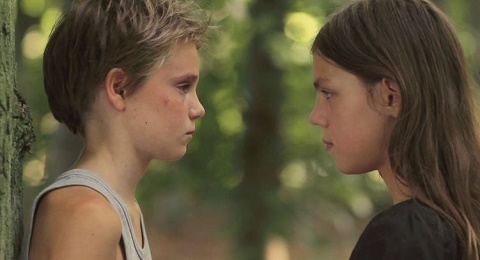
Ten-year-old Laure (Zoé Héran) has moved into this suburb of Paris with her family, pregnant mother, father and little sister, and is wondering what she can do to make life easier for herself. She liked the apartment that is her new home, and her bedroom with its blue walls, but the fact remains once the summer has ended she will have to go to school, and to get by as smoothly as possible to do that she needs friends. However, as she surveys the scene from her window, she notices a group of boys playing games, and decides she would like to join in, but doesn't know if she would be welcome because she is a girl. Regardless, she gives it a try, but when she is approached by another girl, Lisa (Jeanne Disson), and asked her name, something makes her say "Mikael".
Writer and director Céline Sciamme continued her exploration of the personalities of young girls by going even younger than her first film Water Lilies and her next film Girlhood, as Laure had yet to hit puberty. This makes her ploy easier to believe, and the actress had her hair cut short as well as being physically skinny and slight, which made her more convincing as a boy, but this was not really a film that tackled the serious issue of transgender, even though it was adopted as that in some quarters, especially welcomed by the "gay community", for want of a better phrase. You had the impression that was fine by the director, any appreciative audience is good news for a filmmaker, but on watching, it was unexpectedly subtle.
Therefore Laure was not the crusader for greater understanding on the subject that the little hero of an earlier French film La Vie en Rose was, and in contrast this was a lot less fantastical in its approach, being mundane almost to a fault were it not for Laure's dilemma. Perhaps the best aspect was that the story simply accepted her choices, did not pass judgement when there were going to be plenty who would do that anyway, it purely presented her as starting out impulsively posing as male and then getting to like the idea when she sees how she is perceived, in contrast to the way that, for instance, girls would not be allowed to play football - Lisa says she would like to join in, but the boys declaim her as "crap" at it, so Laure already has an advantage over the stereotypes.
When she sees a boy she likes taking off his shirt to play and spitting, later back home she practices such behaviour in the bathroom mirror, and the next day has started to emulate him; in a slightly cruel bit of humour, when he wanders to the edge of the pitch to relieve himself, Laure realises there's still male things she cannot do, and ends up humiliating herself when she heeds the call of nature. Meanwhile, Lisa takes a liking to Mikael, and this increased acceptance becomes addictive to Laure, going to all sorts of lengths to sustain her new persona. Yet she is so difficult to read that it is as if Sciamma had made her more of a blank than she needed to be, just so we could interpret her behaviour in the manner that we would be most comfortable with, and though this was largely a gentle experience, a little more steel wouldn't have gone amiss.
That said, what was on offer was compelling enough, and the interactions of the girl’s family rang very true, with Laure's father (Mathieu Demy) fully supportive and loving (the scenes the two actors share together are warm and sweet), and the interest her little sister Jeanne (Malonn Lévana) takes in her maybe overemphasised in a cutesy manner, but winning all the same. Her mother (Sophie Cattani) is a different kettle of fish, not because she doesn't like her daughter playing around with her own gender, but because she has been lying and that had gotten her into a fight; that’s another apparent advantage of being a boy, you can beat people up (!). You do wish there had been more understanding once the truth is revealed, but the final second (yes, it takes that amount of time) implies that it's possible Laure will be accepted whether she is a straight tomboy or homosexual fumbling her way to her teenage identity. It is ambiguous, deliberately so, but not really knowing was what made this stick in the mind, and it was almost amused about the way the premise messed with expectations on all sides. Music by Jean-Baptiste de Laubier.