Mark Hogancamp was attacked outside of a bar one night and beaten so badly - stomped in fact - that he fell into a nine-day coma while doctors struggled to save his life and rebuild his ruined head. He did survive, but the Mark from before the beating and the Mark afterwards were different people, mostly because after about forty days of hospital care and therapy, he ran out of money and was forced to leave. That in spite of him barely having any memory of who he was and how to read and write; fortunately he had support from his friends and family who helped him through his nightmare, but even now, when this documentary catches up with him around ten years afterwards, he hasn't recovered. But he has found a way of coping...
Fans of outsider artists may be aware of Hogancamp's efforts to apply his own therapy to himself, but one suspects specialist knowledge would not be widely available about his situation until you actually watched director Jeff Malmberg's film on him, and even then it remained one of those small efforts that not many would have sought out outside of the documentary addicts for whom this appeared to have been chiefly aimed at. But don't let that put you off, nor the relative low budget of the enterprise, for the man's story was at once sad and hopeful, trying to take a positive out of a negative when the alternative, that Mark succumbed to his demons after the attack, was too awful to contemplate.
He fully admitted to being an alcoholic, and when he mentions a broken marriage that he barely recalls you infer that was what pushed him over the edge, maybe he was even drunk when he was set upon by five young men outside that bar. But Malmberg was withholding information that in retrospect seemed fairly clear, as it was not the alcoholism that caused him to be almost murdered, it was a dreadful intolerance for those who are different in some way, though not in a way that would have hurt anyone. Mark found a method of coping with his trauma, not one that brings him into contact with the world, however, this was a realisation of the fantasy life that was going on inside his own head.
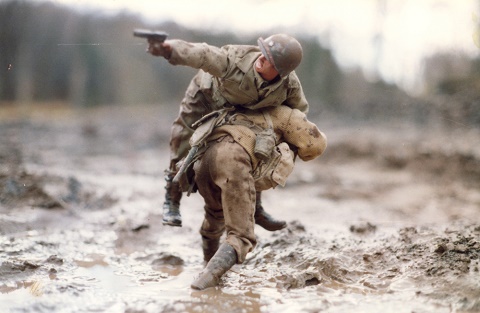
It's no secret from the start of this that Hogancamp loves to play with dolls, and he makes up entire narratives which he played out in his backyard. Yet he went further, fashioning intricate models and details to create his own World War II Belgian village which is under occupation by the Nazis but represents a haven from the horrors of the conflict, at least for the most part, representing somewhere the soldiers and the women who love them can interact. Alas, just as Mark was attacked, so are the soldiers (of many nations), when the SS swoop down, and it's not difficult to see the representation of himself as the doll nearly tortured to death as a rather blatant attempt to work through the injustice and violence that brought him to this lonely life he conducts. That said, he is always saved.
And he is saved by the women of Marwencol (the name of the village is made up of the names of important women in Mark's life), which is more significant than you could possibly know when his story begins here. He obviously adores women, but given he is no longer able to have a proper relationship thanks to his mental health problems, he can act out his romantic (and even sexual) fantasies with the retooled Barbies he recruited for his backyard adventures. It's all very sweet, but melancholy and at times disturbing when you are frequently reminded of what brought him to this peace, which remains fragile when the thoughts of what sent him to this thwarted existence are always looming while the more useful memories do not. Malmberg caught up with Mark as he prepared for his first Greenwich Village art show, and the artist is obviously very anxious yet also full of anticipation: you feel that too. Utterly non-exploitative, this film drew out a confrontation of simple prejudices against harmless eccentrics supposedly treasured by small communities that even as it almost dispassionately depicted its subject, made the audience think very hard about their reactions. Music by Ash Black Bufflo.