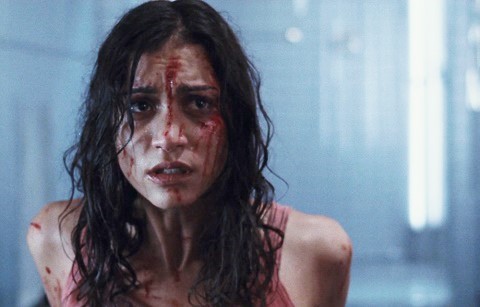
Fifteen years ago in 1971, Lucie (Mylène Jampanoï) was a young girl who had been kidnapped; somehow she escaped her abductors after a terrible torture session and was taken to a children's home for abuse survivors where she made friends with Anna (Morjana Alaoui) who became her closest, and indeed only, companion. But Lucie was a damaged soul after her ordeal, and though Anna could understand what she had been through as an abuse victim herself, she had no real concept of the dreadful circumstances haunting her pal's mind, to the extent that Lucie would see an intruder trying to torment her as it managed to access her bedroom in impossible ways. What could have possibly been the point of all this?
What could anyone get out of victimising someone so severely? We did discover that in director Pascal Laugier's controversial Martyrs, but that was part of its problem: it was so divorced from the real world that its posturing to divine what the benefits of torture could be to the torturer came across as rather facile. He had written it to take the form of a succession of twists and turns, variations on the horror movies of his youth (this was dedicated to Dario Argento) that would break off into tangents that were not only surprising but shocking. The trouble with that was his endeavours to create something original simply encouraged a rather banal conclusion that involved a murderous cult.
After the introductory ten minutes of establishing Lucie and Anna's plight, and that Anna was the more sane of the two, we jump forward to the present, or fifteen years after at any rate, to find them both fully grown but mentally unbalanced, Lucie more than her best friend. Actually, we are shown an apparently normal family first who as they are breakfasting are interrupted by Lucie with a shotgun and supply of shells, convinced that the mother and father are the ones who were the kidnappers. Initially, we can write this belief off as her mania, but once the bodies are lying around the swanky home Anna gets in contact and arrives to clean up the mess, trying to reason with the crazed Lucie who is seeing her demon again.
This turn of events would make sense in an abused becomes the abuser narrative, especially if the slaughtered family were innocent, yet Laugier was unwilling to explore that avenue as he preferred to plough his own psychological furrow that spoke less to challenging insight and more to getting your morality from watching horror flicks where the common result of a transgression is death, and often gory death at that. When Anna finds a torture victim in the home of the deceased, she is together enough to attempt to help the woman, but she is too far gone to be reasoned with, which you could argue was the case with Lucie thanks to her experiences that she will never recover from, leading to the extremely arguable conclusion that self-destruction is the preferable alternative to somebody else destroying you.
Anna and Lucie are merely there to be exploited, and after a while you may regard the actresses in that position as well as the parade of bloodshed and beatings numb the emotions to the extent that you query what Laugier was getting out of this. Not that he was disturbed or dangerous like his villains, simply that there was a stunted view of the common horror movie heroine in that her suffering somehow allowed her to achieve a religious transcendence more than some character who simply exists to be bumped off early to demonstrate how evil the bad guy or guys were. This made Martyrs a commentary on the genre more than it was a satisfying story, and as that commentary it didn't add up since the director closed his film with an open ending and unanswered questions (or one very big unanswered question) that didn't so much open the mind as shut down any but the most insufficient musings as to the purpose of what you had seen. Basically, it was no help as it was too wrapped up in the film world for conclusions the real world would have addressed better. Remade in English in 2015. Music by Alex Cortés and Willie Cortés.