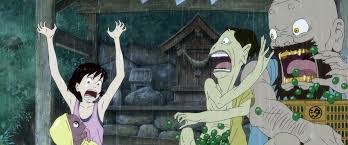
Clinging to an unfinished letter written by her recently deceased father, grieving teenager Momo Miyaura (voiced by Karen Miyama) leaves Tokyo with her perky mother Ikuko (Yuka) to start a new life on the remote Japanese island of Shio. While Ikuko cheerfully reconnects with elderly relatives and a still-smitten old flame, klutzy postman Koichi (Takeo Ogawa), Momo struggles to adjust to her new surroundings. Her mother's attempt to ingratiate Momo with fun-loving local kid Yota (Kota Fuji) only leaves her embarrassed. One day while exploring the attic Momo finds a rare old picture book about goblins and Yokai (Japanese spirits). Whereupon three droplets of water fall from the sky and transform into wacky goblins Kawa (Koichi Yamadera), Mame (Cho) and Iwa (Toshiyuki Nishida) whom only Momo can see.
Fourteen years after making his directorial debut with dour, dystopian allegorical sci-fi Jin-Roh: The Wolf Brigade (1997) veteran animator Hiroyuki Okiura finally produced his second film. Whereas Okiura's initial outing reflected the strong creative influence of his mentor Mamoru Oshii, with A Letter to Momo he seems to have found his own voice. The film mixes fantasy, traditional folklore and slice-of-life drama in a quiet, contemplative manner only anime can pull off. If the art style recalls the late Satoshi Kon and the authentic folklore evokes the king of supernatural manga Shigeru Mizuki, the tone and subject matter are worthy of comparison with Studio Ghibli. Okiura's delicate, expressive character animation beautifully complements the low-key, character driven story. Also as a writer he exhibits a keen grasp of how real people react in real situations, contrasting lively, outgoing, deceptively cheerful mum Ikuko with awkward, introverted daughter Momo, still guilt-ridden over an argument she had with her father right before he died.
An American take on this particular plot would most likely be a horror film. By contrast A Letter to Momo adopts the more humanist, Shinto-influenced attitude to the supernatural common in Japanese genre fare. At first the Kawa, Mame and Iwa make mischief around the Miyaura household. A battle of wits breaks out between the broom-wielding teenager and the invisible goblins as they steal her stuff, eat her food and use her toilet (!) until she turns the tables. Gradually Momo comes to look beneath the surface and sees that yokai are vulnerable, sensitive if eccentric folks, not too different from humans. More scared of people than we are of them. The plot is a little directionless for the first thirty minutes or so but never dull. After Momo and the goblins reach an uneasy truce things grow increasingly lively, endearingly weird and very funny indeed including a riotous sequence where the characters flee an enraged wild boor. For all the hilarity that ensues, Okiura's film is really about coping with loss. Momo is haunted by the notion all trace of her father's memory will soon vanish as she grows up especially given her mother seems alarmingly eager to move on. Of course appearances can be deceptive.
Ultimately A Letter to Momo shows how people deal with grief in different ways. In typical Japanese fashion one's outward behaviour does not always reflect our inner feelings. Of course one could counter had Ikuko been more open about her feelings none of the misunderstandings that ensue would have happened and the plot could not scapegoat Momo so easily as a 'thoughtless' daughter. Okiura crafts scenes that deftly blend comedy, tragedy and wonder. Nonetheless while the film is consistently involving and often moving it is overlong. Much like Peter Jackson, Okiura does not know when to quit and indulges multiple endings. Yet it remains an animated film that matches artistry with psychological nuance and successfully molds Momo not as a fetish figure but a real teenage girl with relatable issues. Also worth mentioning is the memorable climax that rolls out an entire army of goblins and yokai in a nod to vintage Japanese genre fare like Yokai Monsters: Spook Warfare (1968).