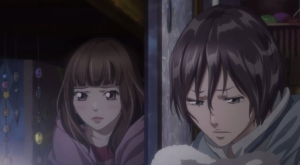
A robot helper named Q01 serves its elderly master in a small Japanese town. One morning they witness a tragic plane accident that claims the life of Hal (voiced by Yoshimasa Hosoya), boyfriend of the old man's granddaughter Kuromi (Yoko Hikasa). Devastated, Kuromi retreats into an almost catatonic shell refusing to leave her tiny room. To help Kuromi cope with her loss the scientists behind Q01 transform the obliging robot into a synthetic lookalike of Hal. This new Hal moves into Kuromi's house to become both a live-in helpmate and coax her back into the world.
Alongside the familiar giant robot sagas and intergalactic action-adventures Japanese animation has its fair share of low-key character or idea-driven science fiction along the lines of live action indie fare like Ex-Machina (2015), The Signal (2014) or TiMER (2009). It is the latter which HAL most resembles since it melds a solid SF idea with philosophical undertones and old-fashioned romance in a sentimental though occasionally poignant story. Frankly a world where grief counselors deploy robotic lookalikes of dead loved ones to help the bereaved sounds like a really bad idea. Yet given the Japanese tend to be more open-minded about the applications of robot technology it might not be so far-fetched.
Nonetheless, more than a few viewers may empathize with Kuromi's initial reaction. On first sight she quite understandably recoils from her 'reanimated' dead boyfriend and locks herself in her room. Gradually robot Hal (whose name presumably alludes to the like-named super-computer from 2001: A Space Odyssey (1968), which if you think about it is a poor choice of A.I. to reference) inveigles his way into Kuromi's life. He cooks her meals, cleans house, does her daily shopping and makes friends with the neighbourhood kids and the sweet old ladies at the old folks' home. In other words, Hal becomes the Japanese schoolgirl ideal of the perfect docile non-threatening boyfriend. He even coos over cute accessories and cuddly toys. All of which reflects the current debate in Japan over the supposed emasculation of men in popular culture rather than any weightier themes.
Co-produced by the lauded Production I.G. studio, HAL is animated with great artistry mixing traditional two-dimensional drawing with subtle and dramatic use of computer-animated imagery. Sadly the plot by comparison, much like its titular robot hero, is skin deep. Hal's scientist-sensei says all he has to do is make Kuromi feel good because "that is all human beings need." Thus the story reduces complex human emotions to the level of greetings card sentiment. Some critics have suggested at barely an hour long the film is too short to explore such concepts in any meaningful way. Yet other anime accomplished more with even shorter running times. Things grow more interesting once Hal/Q01 learns original Hal was far from the perfect boyfriend. However his big mysterious argument with Kuromi turns out to be completely mundane, even inane. Late in the day trouble intrudes on an otherwise genteel romantic drama in the form of human Hal's estranged, disreputable pal Ryu (Mamoru Miyano) but the subplot about organ-stealers and an artificial heart is far too vague and sits awkwardly with the overall contemplative tone.
The final mind-bending M. Night Shyamalan-style surprise twist is effective but comes totally out of left-field and arguably undoes the entire premise. HAL's pastoral setting and quirky humour are intermittently endearing but given the promise inherent in this fable about quintessential human notions of grief, loss and mortality seen through the eyes of an ageless machine, the end result is regrettably lightweight.