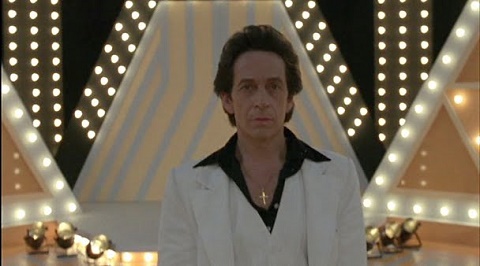
Raúl Peralta (Alfredo Castro) finds himself a fifty-two-year-old unemployed Chilean with no prospects under General Pinochet's regime, but he does have something to take up his time: it is 1978 and Saturday Night Fever, the film, has taken the world by storm, and it is this which obsesses Raúl. He goes to watch it in the cinema as many times as he can, and is learning all the dance moves of star John Travolta so that he may recreate them for a modest show he is planning with his girlfriend, her daughter and one of the local boys. But he has bigger dreams than that, believing if he can win a lookalike contest on television, he may actually become Travolta's character Tony Manero...
Director Pablo Larraín had made a film prior to this one, but here was where he attracted the international interest as if it wasn't as internationally popular as Saturday Night Fever, it certainly was one of those films which generated a fresh interest in South American cinema come the twenty-first century. Being a work from Chile, as many of them did it had the long shadow of the fascist dictatorship looming over it, and Larraín often worried over the details of life under that regime in his productions. But this was a character study as well, and that character was one of the most offputting personalities imaginable, a pathetic, murderous and monomaniac individual bringing nothing but misery.
Within the first ten minutes he has beaten an old lady to death, one who he pretended to assist back to her home when she was mugged, a crime he is never arrested for as with all his other crimes, as if the authorities were so caught up in their secret police-run society that they simply could not rouse themselves to look into genuine lawbreaking instead of being preoccupied with any little misdemeanour relating to the citizens who might have voiced a complaint about them, hauling off people to be tortured and murdered when it is not those victims who are the major problem. A climate of fear is palpable throughout the story, presumably intended to make us ponder who the real criminals were.
Well, obviously it was both the government and the, in comparison, small time evildoers like Raúl, not that they work in conjunction, but neither were exactly making life under Pinochet anything close to acceptable. For much of this Larraín's precise point was rather inscrutable, with blank-faced characters giving little of their inner lives away, whether that was down to the acting or the effects of having to keep their true feelings secret was a matter of debate. Certainly there was nobody to sympathise with other than the poor folks who wound up dead or victimised, and as Raúl was the focus even at ninety minutes Tony Manero was not trying to make any friends with the audience, indeed it was rubbing your nose in the squalid minds running the country.
Which appeared to include Raúl as the ultimate expression of the horribly shallow citizen who would thrive under the fascists, in love with an example of American pop culture without taking anything away from it but the surface qualities as anything deeper would force him to face up to his shortcomings. He is impotent, both sexually and socially, so by appropriating Saturday Night Fever he can become cool by association, though anyone can see the only person really taking that seriously here is himself. As he worries over pointless trappings like building himself a disco floor that lights up, there are hints this was intended at least partially as a black comedy, yet it was so relentlessly downbeat you would need a particularly strong sense of humour to find much to chuckle about; the occasional mirthless laugh, perhaps. As Raúl continues on his path, killing the projectionist who replaces his favourite with Grease (illustrating the ephemeral nature of movies and politics) or shitting on the white suit of a rival, it’s difficult to stay engaged.