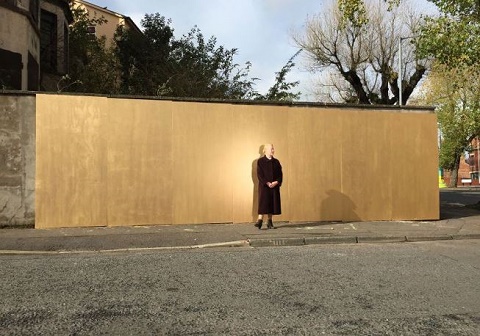
Mark Cousins is from Belfast, but he left the place, as so many did, when he was about twenty years old. However, he has never quite gotten the city out of his system, and now, thirty years later he feels he is ready to return and make one of his documentaries about it, which he did not wish to approach in too conventional a fashion. Thus he found a character (played by Helena Bereen) who embodied Belfast, told him she was Belfast, and could guide him and his audience around centuries of the location with a wisdom born of experience. At first she is keen to emphasise the beauty and colour, the notable sons and daughters of the area, but before long both she and Mark realise there is something they really have to discuss...
I Am Belfast was not, as some thought, divisive critic and filmmaker Cousins announcing he was the personification of his city of origin, that mantle was on the woman who took most of the narration, written by himself, as a method of introducing the people, culture and yes, the Troubles in a fresh way that did not rely on endless archive footage of destruction and locals decrying what had happened to where they lived over the years that had brought so much murder on a huge scale. One reason he split opinion was his insistence on performing the narration of his productions on his own, and for many his vocal cadence drove them up the wall and was impossible to listen to, therefore they may get along better with this.
Cousins interjected at points along the way, but it was Bereen who spoke most of the words, and if you actually liked his voice and found it charming and soothing, then you may be a little let down that you heard so little of it here. But they were unmistakably his words, given his striving to tell the story he was compelled to relate in his own idiosyncratic fashion as he tried to make sense not only of Belfast but his relationship to it; would many of us be able to speak with such lucidity and with these quirks of perspective that brought the place into sharp relief as he did? You may wonder if you would really want to, yet Belfast had such a contentious history, especially in the twentieth century which had spawned the uneasy peace of the twenty-first, that it begged for this style.
As personal as this was, in spite of Cousins putting his lines in someone else's monologue, there were spaces for other's views, most notably the pair of pensioners who had been friends for over fifty years in spite of the apparent difference in their background, for one was Protestant and the other was Catholic. This highlighted that no matter how far the citizens believed they had little in common thanks to religious divide and national sympathies, these two had discovered they shared a lot more than they differed, and their expletive-riddled humour was one of the best parts of the film as Cousins marshalled some kind of interview with them only to see them take over his project for a good five minutes or so. People like those two offered hope, and you understood that was extremely important to the director.
For the first half hour, the emphasis was on famed cinematographer Christopher Doyle's imagery and how striking the city could look; you would hesitate to call it beautiful as Cousins was apparently aiming for, but handsome was a word that seemed apt for Doyle's trademark techniques with bright, contrasting colours. But then they had to address the subject for which Belfast is notorious throughout the world, and as the narration says, it’s something they both wanted to confront but were simultaneously afraid to bring up when it had bred so much misery and fear for so many. We learn that almost half of the city's population upped and left in about twenty years since 1971, and from the snippets we hear, and occasionally see in archive clips, we can well sympathise that leaving would be an attractive proposition rather than staying, especially when those anecdotes can be so harrowing and we question how anybody could have got used to living under that. If finally Cousins didn't quite nail the region with his singular methods in a manner that would mean more to anyone else other than himself, his insight and compassion, the presentation of the view that there were natives who would celebrate when the last bigot had died, were undeniably valuable. Music by another Belfast local made good, David Holmes.
[The BFI Blu-ray comes with an array of featurettes, including a making of and interviews, as well as a walking guide around the city and the trailer.]