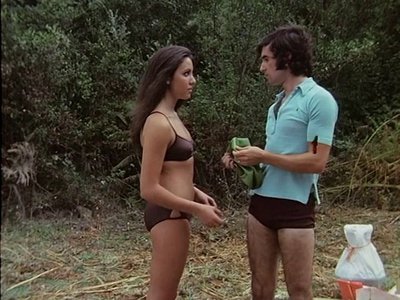
Newlyweds Alicia (Ana Belén) and Diego (Victor Manuel) head straight from the chapel to their caravan for a honeymoon in the countryside. Alone in an isolated woodland area they dine on champagne and caviar, open their wedding gifts, sunbathe and make love. Yet Alicia has this nagging feeling they are being watched. Diego dismisses her fears. But when the couple run low on water Diego is oddly reluctant to go to the well near a creepy old abandoned farmhouse. Then Alicia's wedding dress mysteriously disappears. Still it remains uncertain whether Alicia is merely paranoid or someone is truly out to get them.
Morbo proves one of the strongest Spanish psychological thrillers uneasily lumped into the giallo category. By comparison with the more overwrought, semi-parodic hysteria practiced by such cod-gialli as Sexy Cat (1973) or A Dragonfly for Each Corpse (1973), this is a much more subdued, serious and ambitious work. Despite an impressively varied career as a sports writer, journalist, avant-garde author and filmmaker, Gonzualo Suarez remains best known for acting in Pedro Almodóvar's What Have I Done to Deserve This? (1984). As director and co-screenwriter he imbues the film with a palpable sense of unease and menace throughout, from the creepy opening conversation between unseen inhabitants of the crumbling, fetid rat-infested farmhouse right down to the tense, unpredictable climax. In its use of nature and an unsettling environment to fashion a mounting sense of disorientation and dread, Morbo prefigures later works like The Texas Chain Saw Massacre (1973) and Long Weekend (1977), but with less emphasis on visceral thrills than the psychological.
Rather than rack up a bloody body-count, Suarez uses the trappings of the backwoods terror sub-genre together with the killer's almost childishly malicious pranks to chart a disintegrating relationship. Going back to nature like Adam and Eve strips away the romantic facade and civilized pretenses, exposing Diego and Alicia's base impulses and brittle neuroses. Morbo initially establishes them as upwardly mobile, educated and sexually liberated. No sooner have they left the church then Alicia strips out of her wedding dress into a fetching bikini while Diego comes across very much the self-satisfied, psychologically-savvy bourgeois hero. Yet once they have crossed the threshold into stark nature, Alicia's latent conservatism reasserts itself. She feels ashamed at the thought of someone watching them together while Diego is increasingly unsure of his own masculinity. The film is very well acted by singers-turned-actors Ana Belén and Victor Manuel who actually fell in love on the set, married and remain so to this day. Neither actor opts for the histrionics common in giallo fare but instead lace their roles with subtle psychological nuances to match Suarez's poetic use of symbolism. Suarez takes the time to establish the two central characters as complex individuals that long for freedom but are at a loss as what to do with it.
Aside from one sequence involving a drowning rat, liable to rattle modern sensibilities, Morbo is a classy affair. Though the beautiful Belén remains scantily-clad throughout, happily this is not one of those thrillers out to punish women for their sexuality. For the greater part of its running time the film dwells on Alicia's paranoia. Even after a tangible menace appears in the form of cherubic American character actor Michael J. Pollard, on screen for all of five minutes or so, the film keeps the viewer off-balance as to whether the threat is real or imagined. As things play out in pleasingly unfamiliar and unsettling fashion we are left uncertain of what is right and wrong and what the future holds. Manuel and Belén re-teamed with Suarez the same year for Al diablo, con amor (1972). His other films include the Moliere adaptation Don Juan in Hell (1991), El Portico (2001) the story of a Spanish soccer player in the post-Civil war era and, interestingly, Rowing with the Wind (1988) which paired another future famous off-screen couple Hugh Grant and Elizabeth Hurley in a story about Frankenstein author Mary Shelley.