Powers of Ten is a film about the relative size of things and the effect of adding a zero. It begins with a man enjoying a picnic with his lady friend; he lies down and sleeps contendedly on the rug in the middle of a field. This is our starting point as we gradually pull back from his location, every ten seconds adding a zero to the distance in metres from the man as more and more of the bigger picture and his place in the universe is revealed...
You know "The Galaxy Song" from the film Monty Python's Meaning of Life, which details the wonder of the universe and all its myriad marvels? Well Powers of Ten, created by husband and wife design team Charles and Ray Eames, is kind of the visual equivalent, only without the abrupt crash down to Earth at the last line. We keep track of how far out we are via a counter at the side of the screen, which rises from the lowly ten to the power of two or three until it reaches the giddy level of ten to the power of twenty-four, a vertiginous distance practically at the edge of the known universe.
Powers of Ten started life as an experimental film in 1968, informally named A Rough Sketch, which basically covered the same ground (or space, depending on how you look at it). Around that time a similar film called Cosmic Zoom was created, which had less of a scientific angle, and started with a boy on a rowing boat on a lake which was gradually "zoomed out" from until the solar system was revealed. In the nineteen-seventies, The Eames returned to their Rough Sketch for I.B.M. to create the most famous version of this hypnotic idea.
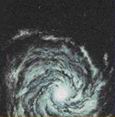
As we have watched, trance-like, the whole of creation pass before our eyes, a narration (by Philip Morrison) which stays between the twin poles of matter-of-factness and enthusiasm has told us about the science of what we are seeing. As every power of ten is passed, a square appears on screen as a marker, and our solar system dwindles to a single point of light. The Milky Way galaxy grows more apparent in shape, then shrinks itself, joined by other galaxies until the screen is filled with tiny dots representing untold billions of stars. But it doesn't end there.
Once we go as far as we can, the film is reversed at a faster speed, and we hurtle back the way we came until we see the man at the picnic again. As with the previous Cosmic Zoom, we get closer to the sleeping man's hand, with the texture of his skin becoming clearer, then the blood cells, and finally we reach an infinitesimal level to go inside an atom. While Powers of Ten is undoubtedly meant as an educational film, you hardly concentrate on the narrator as you travel through space - the whole presentation is a delight, even if it does leave you feeling, after you've said, "wow", strangely insignificant... so perhaps it is a little like The Galaxy Song. Music by Elmer Bernstein, which could do with more swooshy noises.