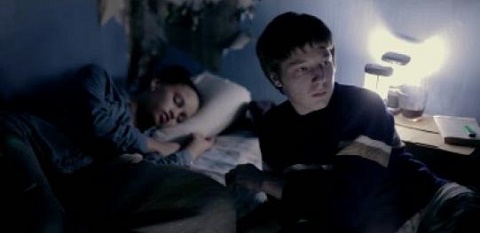
Tommy Turner (Clem Tibber) is a teenage boy whose parents have split up, and now he has to go and live with his father Mark (Shaun Dingwall) who is something of a ne’erdowell. He tells his son that they will have to stay in this rundown estate, so rundown in fact that it has been earmarked for demolition, but before that happens, if it ever does, Tommy will move into one of the abandoned flats with his dad who will in the meantime help himself to whatever he can there to make a bit of ready cash. As if this depressing state of affairs was not bad enough, when he goes outside to draw and listen to his CD Walkman, he is approached by three thugs who try to steal from him - but Carmen (Elarica Gallacher) steps in to save him.
Who is Carmen? Ah, there lies a tale, as she is the equally teenage girl who works in a local café and reluctantly takes Tommy under her wing seeing as how Mark is not doing much in that capacity himself. But what intrigues her about his story was the reason we were here, to watch a ghost yarn when the kid starts believing there are mysterious noises going on in the flat next to his and his imagination runs riot as he supposes these are not the effects of a living, breathing person but actually the presence of someone who used to live there and does no longer, after all, nobody lives in this estate now, do they? Or do they?
Well, Tommy and Mark do, but all is not what it seems there either in a supernatural chiller concocted by director Oliver Frampton and co-writer James Hall, both alumni of Brit cop soap The Bill once upon a time and still working mostly in television before and after The Forgotten. Incidentally, this was not to be confused with the Julianne Moore missing child science fiction movie of ten years before this film's release, and though the title was apt here, you did sort of wish they had come up with something more distinctive to call their endeavours when the chances of Moore's efforts being forgotten were less likely than these considerably lower budget efforts as conjured up by Messrs Frampton and Hall.
All that said, though they might have been glad of more money to spend, there was a genuinely oppressive mood here that was as much the results of working within slender means as it was the contrivances of the script. It may have been that it ticked off a checklist of bullet points for twenty-first century British kitchen sink drama, including the setting of an estate that has seen better days, a single parent, low level crime, mental illness, overcast skies suffused with a dreamy sunlight from behind the clouds and so forth, but at least there was a conscious attempt to do something different with some very familiar elements and not simply regurgitate the entire oeuvre of Andrea Arnold or her ilk.
That something different rested in the horror genre, and though there was little gore, there was more than misery porn for those who like to dip into the lives of the underclasses as it did build to a very credible and effective turn of events where you begin to doubt the person you had been assuming was the main character really was the protagonist, and it might be somebody else instead. That the status quo was reasserted before the end was for a change in such a plotline nothing to be reassured about, at once a recognition of victims who are all too easily brushed off as statistics and whose humanity can be cast aside thoughtlessly, and also a more self-aware go at developing an ending that stuck in the mind precisely because it was what you didn't want to happen rather than the opposite. With a collection of doleful performances not quite lifting the material that possibly didn't need to be lifted anyway and therefore were in fact spot on, The Forgotten moped along in its misery, yet remained engaging enough to stick with to see where it was going. Music by Paul Frith.