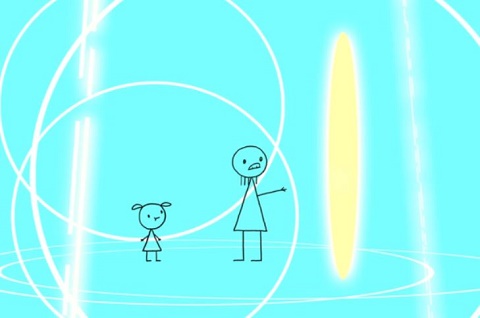
Emily Prime (voiced by Winona Mae) is so-called because she is the first of her line, a line of clones that stretches into her future. But one day she notices a screen has appeared and she wanders over to it to see what it is showing, to find that one of her future selves is speaking to her, also called Emily (Julia Pott). This Emily tells her that she is Emily Prime's clone, and she has been copied by giving birth to herself a few times over down the centuries, they all share the same memories, the ones originated in the little girl original. And so this clone takes the ancestor on a tour of the future, with all the magic and drawbacks that entails...
The point being, no matter how advanced technology becomes, the human race has no guarantee of being able to use it sensibly or even cope with the repercussions it will bring about for simple interaction. Don Hertzfeldt was the brains behind this Oscar-nominated short cartoon, his first to use digital methods but still presented with his trademark stick figures as characters. That mixture of bizarre, blank faced humour and a deep melancholy and worry for the world was well to the fore, and many considered it his masterpiece, which for a film that lasted barely over fifteen minutes was not bad going.
He certainly packed a lot into it, almost casually throwing away frequently disturbing observations about how inadequate we would be as the years went on as asides, with clone Emily instructing Emily Prime in information the little girl could not have a hope of understanding, yet somehow standing in for anyone, no matter what age, who has to face up to the experience of living and how they will never be able to handle all its implications. The clone may be older and supposedly wiser than her source, but there’s no indication even with all these advancements that she has any idea of how to make herself happy.
The dread that it wasn't relevant how far the universe moved forward, the essential impossibility of actually achieving a lasting happiness because at some point, to be final about it, you were going to die, informed the uneasy humour of World of Tomorrow, and the most telling line was perhaps when the clone tells Emily Prime that she will never appreciate how precious and content she could have been in the present because she was always trying to get to a better future. And yet, Emily Prime at four years old has achieved that happiness because she is utterly unaware of the misery that awaits her as life begins to accumulate its disappointments and letdowns.
For that reason you could accuse Hertzfeldt of sentimentalising the early years of anyone on the planet, but he was savvy enough to indicate that's precisely what everyone does, the sense of nostalgia that was fed into everyone's personality as time moves inexorably on, your body and mind deteriorate and you look back on what had been before and wish you could be that happy again, even if you hadn't particularly noticed you were more at peace with yourself then than you are now, a vicious circle of emotion. Sure, there were all those little anecdote-like bits and pieces as the clone tells Emily Prime about what awaits her, from falling in love with a rock to being one of countless citizens who watched an art exhibit of an actual person grow old and die, but that crushing inevitability that it will end and there's nothing you can do to stop it, Hertzfeldt states, means you should really appreciate what you have now while alive. Only you never will, because once you realise it'll be just too late.