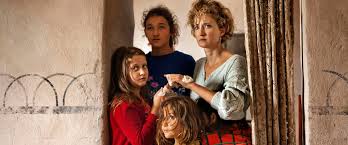
Winner of the Grand Prix at the Cannes Film Festival in 2014 this lyrical, naturalistic, coming of age rural drama centres around Gelsomina (Maria Alexandra Lungu), a twelve-year-old girl running a honey farm with her hippie parents and three younger sisters. Isolated from much of the outside world at a dilapidated old stone farmhouse in the Italian region of Liguria, Gelsomina is an expert beekeeper. She practically runs the entire farm but is insecure when faced with the demands of her German father Wolfgang (Sam Louwyck) and his volcanic temper. Out swimming one morning, Gelsomina and her family stumble across a beautiful host (Monica Bellucci) filming a tacky TV commercial for a regional food contest called 'Countryside Wonders.' Gelsomina firmly believes their honey could win first prize and change her struggling family's lives for the better but Wolfgang has no intention of exposing their unique way of life to the outside world. Meanwhile a young German boy named Martin (Luis Huilca) arrives to work as a farm hand for the season as part of a youth rehabilitation program. His presence sparks a string of mishaps that alters Gelsomina's world forever.
Some critics drew comparison between Alice Rohrwacher's charmingly dreamlike yet emotionally honest coming of age fable and Ermanno Olmi's seminal, Palme d'Or-winning account of peasant life: The Tree of Wooden Clogs (1978). Both films find sublime moments of poetry amidst the mundane everyday reality of living off the land but are unsentimental about rural life. Inspired by memories of her own childhood working for parents who were also beekeepers, Rohrwacher shows clearly how raising a family while tending a small rural farm is bloody hard work. Not just for adults but young children too. Harsh weather, unstable equipment, a dilapidated house and frayed tempers all take their toll. Yet the rewards of a close-knit family and pride in producing something exceptional from the land offer satisfaction unlike anything else in life. As they say in the film, "Certe cose non si possono compare" (certain things you can't buy).
For Gelsomina and her sisters hardship is simply a fact of life. In low-key, slice-of-life though nonetheless magical fashion former documentary filmmaker Rohrwacher details how these young girls raid the hives in old, worn-out protective suits that get them routinely stung. Through hefty work they press the comb and gather the honey in buckets, careful not to spill a single costly drop lest they spark another of Wolfgang's raging tantrums. Flemish actor and dancer Sam Louwyck portrays the patriarch as a complex mix of idealist and paranoid neurotic. Wolfgang is a bully, dictator and misogynist and not even as knowledgeable a farmer as his own eldest daughter. People keep asking the father of four when he is going to sire a son and, although grooming Gelsomina to take on the family business, that clearly rattles his masculine pride. Nevertheless Wolfgang is also passionate about his unique way of life. He seeks to isolate his family from a world he sees as fraudulent and worthless and, judging from the terribly tacky 'Countryside Wonders' contest, is not entirely wrong.
Inevitably, as with many adolescents, the smart and capable Gelsomina grows weary of the same familiar routine. Tired of merely surviving, she wants to live and so latches onto the contest as a means to improve their circumstances. There is an understated fairytale element to Le Meraviglie (The Wonders) with the film's sole star name Monica Bellucci playing a fairy godmother of sorts and Gelsomina herself drawn as a Sleeping Beauty figure trapped in a kingdom slumbering under a spell. Yet Bellucci's character is simply a store-bought illusion bedecked in tacky tinsel. She grants no wishes but does point the way to another way of life. While Rohrwacher serves no fairytale ending she imbues Gelsomina with hope through the simple truth that life goes on. The disintegration of the relationship between father and daughter is drawn in an affecting and believable way though the film is unnecessarily vague in other areas. Martin remains a very enigmatic figure. Unable to communicate with his Italian hosts he harbours his own secret neuroses but never utters a word. Even so the blend of German and Italian cultures lend the film a unique texture. Spellbinding from the first frame to last the visuals conjured by French cinematographer Helene Louvart, who shot Rohrwacher's first fiction film Corpo Celeste (2011), speak more eloquently than dialogue. As a result of their combined artistry The Wonders expertly captures the unspoken feelings between parents and children.