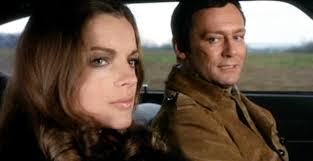
Feuding couple Marina (Romy Schneider) and Claude (Gabriele Tinti) speed recklessly down the road until their car goes off a cliff into the sea. Marina jumps out just in time but her boyfriend is missing, presumed dead. Police arrive on the scene along with Claude's estranged older brother Serge (Maurice Ronet). With Marina too unnerved to be left alone Serge lets her stay at his house. As time passes they grow closer and Serge realizes he is falling in love. Yet he cannot help feeling the facts behind Claude's death do not add up. Marina's increasingly suspicious behaviour prompts Serge to ponder if he truly knows what kind of woman she is. Could she be a murderer?
Rather like Diabolically Yours (1967), Qui? (Who?) crossbreeds the French psychological thriller tradition of Henri-Georges Clouzot and Claude Chabrol with elements of the more lurid and sensationalist Italian giallo. Reflecting the latter the film features a significant role for Italian actor Gabriele Tinti, a genre fixture in films like Death Occurred Last Night (1970) and Tropic of Cancer (1972) before he moved on to sleazier roles opposite his wife Laura Gemser. Released in English under the alternate title The Sensuous Assassin, Qui? was one only four films directed by Léonard Keigel. A former assistant director to the great René Clement, himself no slouch when it came to crafting taut suspense fare, Keigel's other films: Leviathan (1962), The Queen of Spades (1965) and A Woman One Day... (1977) were all thrillers centred on strong female protagonists.
Qui's main asset is a pair of powerhouse leads. Reunited a year after Jacques Deray's superior La Piscine (1969), Romy Schneider and Maurice Ronet invest their characters with an intense psychological realism that grounds an otherwise kitschy, convoluted thriller. Schneider in particular was in the midst of a concerted effort to break away from the squeaky-clean image carved for her in the much-beloved Sissi (1955) trilogy. She did so with great success in the Seventies with a string of award-winning roles. Here her ambiguous anti-heroine forms the crux of an old reliable thriller premise that harks back to Alfred Hitchcock films like Suspicion (1941), namely can the protagonist trust their romantic partner? Qui? dares viewers to wonder whether the angelically lovely Marina is a cold-hearted killer? Or do we have it wrong? Is Marina in fact in danger from the volatile Serge? Given Serge stupidly tries to jogs Marina's memory of the accident by swerving his own car near a cliff's edge the plot goes all-out to maintain this seesaw of ambiguity. Serge hated his brother, who was an abusive jerk, but still needs to know the truth. Naturally his paranoia does not keep him from sleeping with Marina on multiple occasions because, hey, she looks like Romy Schneider. He would be nuts not to. Yet as things play out both the plot and Serge's behaviour grow increasingly erratic. Haunted by the notion he is falling for his brother's killer, he gets sloppy drunk and crawls onto his balcony to pelt passers-by with rotten eggs, then collapses with laughter beside Marina while his ex-wife Dorothy (Simone Bach) sulks.
Keigel's ham-fisted direction over-emphasizes flashy stylistic devices and a groovy acid rock soundtrack by Claude Bolling (with a theme song later co-opted for Eurotika! Pete Tomb's and Cathal Tohill's excellent Channel Four documentary series about Euro cult films) without reaching the fevered delirium of a really fun giallo. Neither fish nor fowl, Qui? seesaws between shrieking melodrama or overly sedate parlour room chat with no in-between. It can't quite muster the energy of a giallo nor the depth of an arty French thriller. After a crazy third act twist Keigel goes bananas with freeze-frames, split-second flashbacks and a surprise villain magically able to appear in multiple places at once. Though it seems to be building to a twistedly romantic finale, in much the same vein as La Piscine, the would-be moralistic coda seems unnecessary in light of the motivation behind the preceding twist and tacked-on to appease the censor. Interestingly this same ending was lifted wholesale for the altogether trashier giallo The Flower with the Deadly Sting (1973).